
Rust is one of the most demanding survival games to host. Here's how to choose a VPS that keeps a wipe day smooth — CPU, RAM, and storage sizing explained.
Rust is one of the heaviest games you can self-host. Large procedural maps, entity-dense bases and busy wipe days push both CPU and RAM hard. This guide explains what a Rust server really demands so you can buy a VPS that survives the first-of-the-month rush.
Rust is genuinely resource-hungry
Unlike Minecraft, Rust's server is happy to use multiple cores, but a single busy map still leans on strong per-core speed for the simulation. The bigger driver is memory: map size and entity count balloon RAM usage over a wipe cycle as players build.
Defensible sizing to plan around:
- 8 GB RAM: small map (~3000–3500), ~40–50 players early wipe.
- 16 GB RAM: standard 4000–4500 map, 100+ players — the common sweet spot.
- 32 GB RAM: large maps or modded (Oxide/Carbon) servers with many plugins.
Rust's memory use *grows through the wipe*, so size for late-wipe, not day one. See our companion piece on how much RAM and CPU a game server needs for the general rules.
CPU and why wipe day is the real test
The single worst moment for any Rust host is the wipe: hundreds of players connecting, map generating, entities spawning. You want:
- Modern, high-clock CPU with real, non-oversold cores.
- NVMe storage — map generation and save cycles are disk-heavy, and NVMe cuts the freeze on save.
- Headroom above your normal load so spikes don't tank the framerate.
Storage and bandwidth
A Rust install plus a generated map is several GB, and backups multiply that. Budget at least 20–30 GB of NVMe and more if you keep rolling backups. Bandwidth per player is modest, but a full server of 100+ adds up — an unmetered or generous transfer allowance is worth checking.
Open the default ports before players arrive:
sudo ufw allow 28015/udp
sudo ufw allow 28016/tcp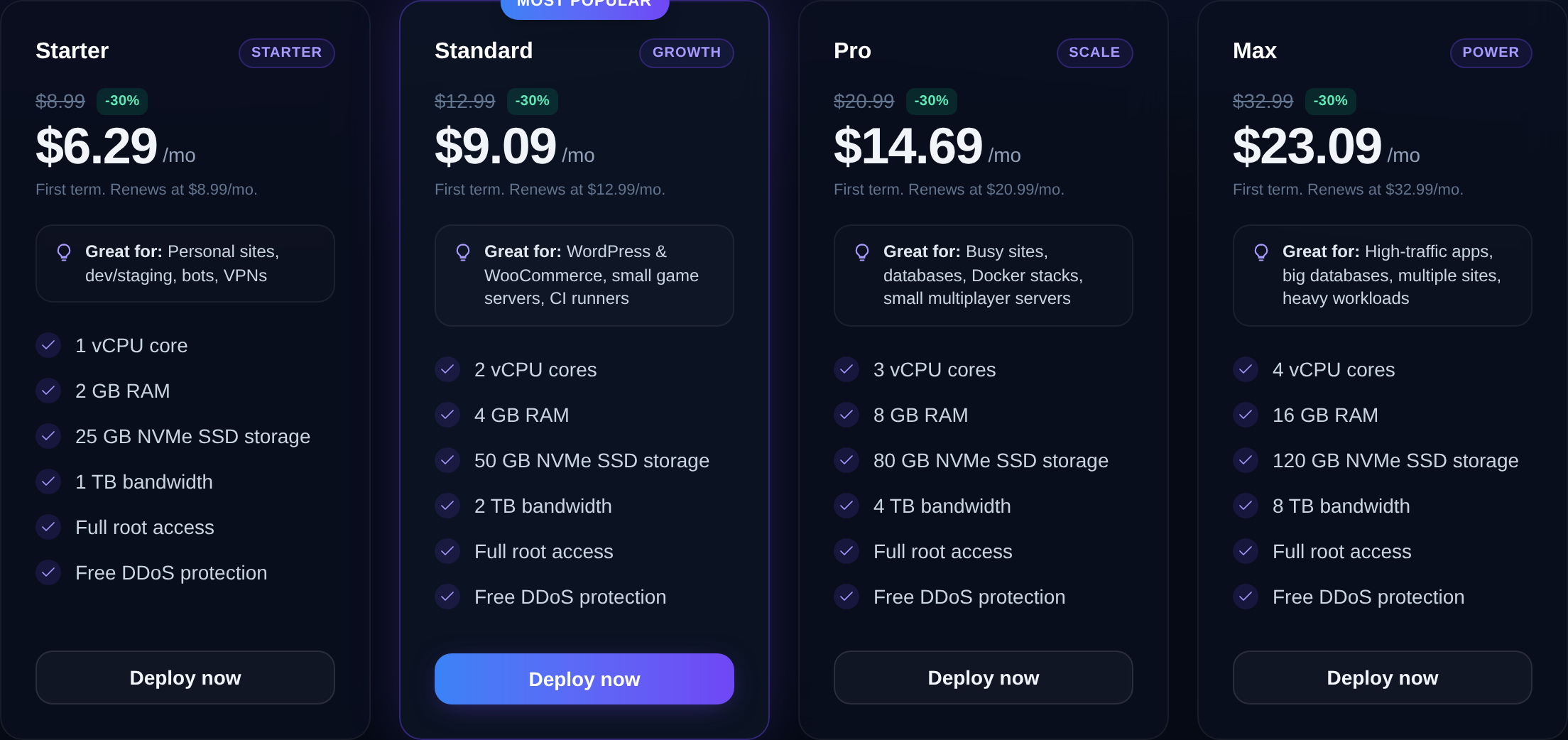
Getting the server running
Rust servers install via SteamCMD and run best under a process manager so they auto-restart and survive reboots. Our full walkthrough covers it end to end: how to set up a Rust game server. Once it's live, you'll want Rust admin commands and wipe management and a solid automatic backup routine. Automating restarts with systemd and cron keeps performance fresh across a wipe.
Vanilla vs modded: plan for the heavier one
Whether you run vanilla or modded Rust changes your hardware needs meaningfully. Vanilla is lighter and predictable. Modded servers running Oxide (uMod) or Carbon add plugins for kits, economies, events and admin tools — each one adds CPU and memory overhead, and a heavy plugin list can add several GB of RAM use on its own.
If you're building a modded server, size up: a plan you'd pick for vanilla will feel tight once you've stacked twenty plugins. Carbon is generally lighter on performance than Oxide for the same feature set, which is worth knowing if you're plugin-heavy. Either way, install plugins deliberately — every one you add is load you carry through the wipe.
Keeping wipe day (and the whole wipe) smooth
The wipe cycle is Rust's defining rhythm, and it stresses the server differently at each stage:
- Wipe day: peak concurrent connections and fresh map generation. This is where under-provisioned CPU shows first as connection queues and rubber-banding.
- Mid-wipe: steady load, bases growing, memory climbing.
- Late wipe: maximum entity count as the map fills with bases, tool cupboards and deployables — your highest RAM use.
Practical habits that keep it playable:
- Restart on a schedule. A daily or twice-daily restart clears accumulated memory and applies updates — automate it with systemd and cron.
- Monitor RAM and CPU through the wipe so you can size up before late-wipe lag hits — see how to monitor server resources on Linux.
- Back up before every wipe and update, and keep a rolling backup mid-wipe in case of corruption.
Because a VPS gives you full root, you control the wipe schedule, the plugin set and the restart cadence entirely — something locked-down game panels rarely allow.
Where Nxeon fits
Nxeon offers NVMe KVM plans with full root access, so you can run Oxide/Carbon, tune your map size and script your wipes exactly how you want. There's dedicated Rust server hosting and clear VPS pricing to match a plan to your target player count — remember to size for late wipe.
Buying checklist for Rust
- 16 GB RAM is the realistic baseline for a 100-player standard map.
- Insist on NVMe and modern CPU cores.
- Size for late-wipe memory, not the empty map.
- Confirm generous bandwidth and disk for backups.
- Get full root so you can run mods and admin freely.
FAQ
How much RAM does a Rust server need for 100 players?
Plan for around 16 GB on a standard 4000–4500 map. Memory climbs through the wipe as bases are built, so pick the plan that survives late wipe, not the fresh map.
Can I run a modded (Oxide/Carbon) Rust server on a VPS?
Yes. Full root access lets you install Oxide or Carbon and any plugins. Modded servers use more RAM, so step up a plan size if you run a heavy plugin set.
Why does my Rust server lag on wipe day?
Wipe day combines map generation, mass player connections and entity spawning. Under-provisioned CPU or oversold cores show here first — buy headroom above your normal load and use NVMe storage.
What ports does a Rust server use?
The game uses UDP 28015 and the RCON/query port TCP 28016 by default. Open both in your firewall before players connect.
Ready for wipe day? See Rust server hosting or compare NVMe plans on the pricing page.
Game server hosting
Deploy in seconds, not weekends
Nxeon · Nxeon editorial
★★★★★ Straight-talking guides from the team that runs the servers.