
Palworld dedicated servers are memory-hungry and scale hard with player count. Here's how to size a VPS so your world stays smooth for you and your friends.
Palworld took off fast, and so did the demand to host private worlds for friends. The catch: the dedicated server is genuinely memory-hungry and gets heavier as more players join. This guide explains how to size a VPS so your world runs smoothly instead of stuttering.
Palworld's real appetite is RAM
The Palworld dedicated server loads a large, persistent world and simulates Pals, bases and players. Memory is the main constraint, and it climbs with player count and world age.
Defensible sizing:
- 8 GB RAM: a small private world, ~4 players — a sensible minimum.
- 16 GB RAM: a fuller server, ~8–16 players, or a long-running world.
- 32 GB RAM: larger groups and heavily-built worlds.
Don't try to run Palworld on a 2–4 GB box; it will struggle. See our companion best VPS specs for a Palworld server for more detail, and the general how much RAM and CPU a game server needs.
CPU and storage
Palworld also leans on the CPU for simulation, so modern, high-clock cores matter — oversold cores show up as rubber-banding and lag. On storage, the install plus a growing save wants NVMe and 20 GB+ of headroom, especially if you keep backups.
Open the default game port before your friends connect:
sudo ufw allow 8211/udp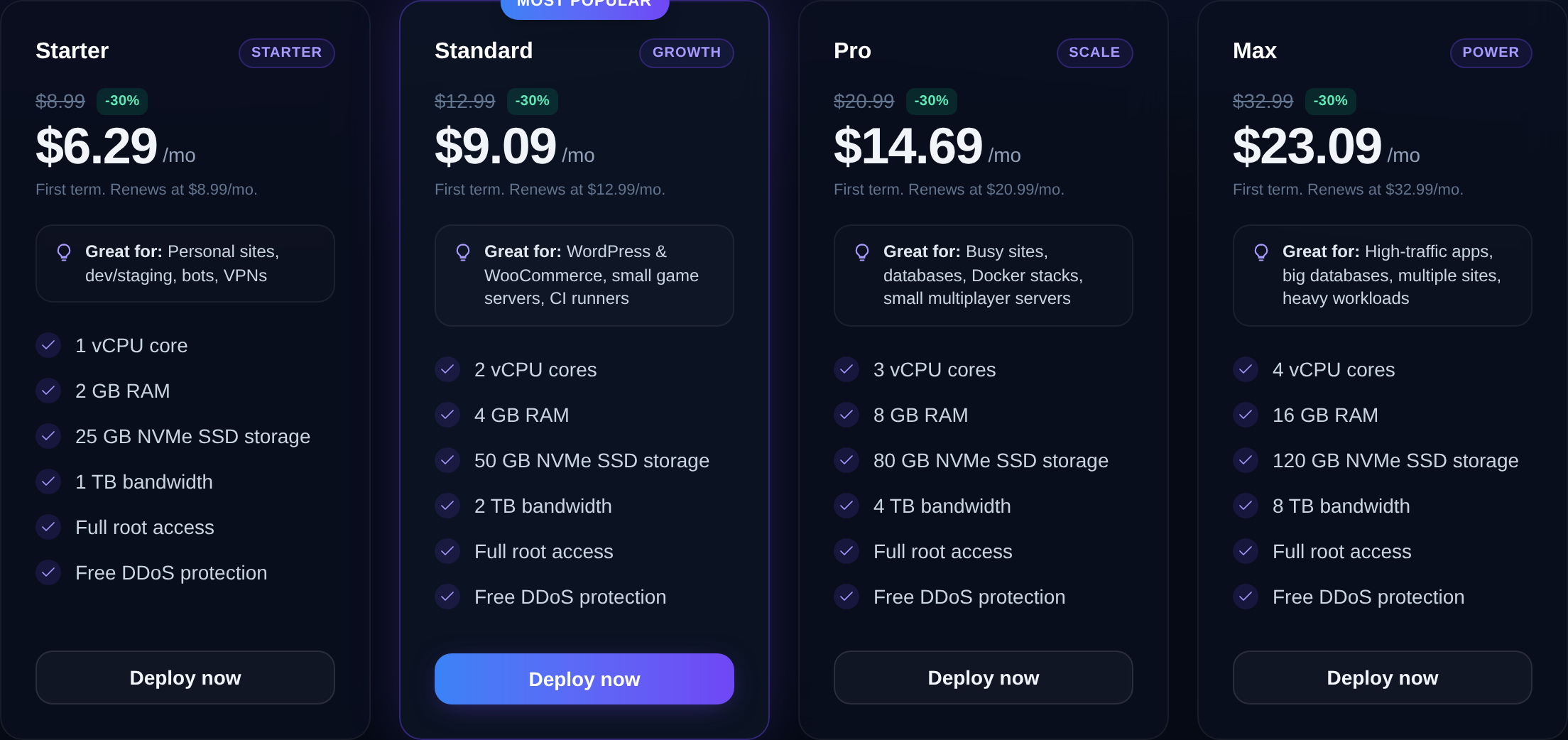
Getting it running
Palworld installs via SteamCMD and runs best under a process manager so it survives crashes and reboots. Our full walkthrough covers the whole flow: how to set up a Palworld dedicated server. Pair it with an automatic backup routine — persistent worlds are worth protecting — and automate restarts with systemd and cron to keep memory fresh.
Location for low ping
Palworld is co-op, so pick a data-centre region roughly central to your group. Our guide to choosing a game server location for low ping helps you balance everyone's latency.
Tune the server settings for your group
Palworld's dedicated server exposes a settings file (PalWorldSettings.ini) that shapes both gameplay and performance. A few worth knowing:
ServerPlayerMaxNumcaps the player count — set it to match the RAM you've provisioned rather than the theoretical maximum.- Rates like capture, gather and exp multipliers tune the experience for a casual or hardcore group.
bIsMultiplayand PvP toggles control how your world plays.
Edit the file with the server stopped, then restart to apply. Because you have full root on a VPS, you can back up this config alongside your save so a fresh setup is a copy-paste away.
Why Palworld hits harder than most co-op games
It helps to understand *why* Palworld is heavier than similar survival games, so you size correctly. The server continuously simulates a large open world plus the Pals working at every player's base — feeding, crafting, building — even when players are offline in some setups. That persistent simulation is what drives memory up over time, and why a world that ran fine on day one can start stuttering weeks later on an undersized box.
The practical takeaways:
- Size for the world you'll have in a month, not the empty starting map.
- Restart on a schedule to clear accumulated memory — automate it with systemd and cron.
- Keep the server updated. Palworld received frequent optimisation patches after launch; running the latest build often improves performance for free.
- Monitor RAM through the world's life so you can size up before lag arrives — see how to monitor server resources on Linux.
This is exactly the kind of long-running, resource-growing workload where a VPS with real, non-oversold resources beats a cheap shared game slot.
Where Nxeon fits
Nxeon runs NVMe KVM VPS with full root, so you can install Palworld via SteamCMD, tweak the server settings and script your restarts. There's game server hosting to get started and clear pricing to match RAM to your player count — remember Palworld wants more memory than most survival games.
Buying checklist
- 8 GB RAM minimum, 16 GB for a fuller or long-running world.
- Modern high-clock CPU cores, not oversold ones.
- NVMe with 20 GB+ headroom for the save and backups.
- A region central to your group for fair ping.
FAQ
How much RAM does a Palworld server need?
Start at 8 GB for a small private world of around four players. Step up to 16 GB for eight or more players or a long-running, heavily-built world — memory use grows over time.
Why is my Palworld server lagging?
Usually under-provisioned RAM or oversold CPU cores. The world simulation is demanding, so buy headroom above your normal load, use NVMe storage, and keep the server updated.
What port does a Palworld server use?
The dedicated server uses UDP 8211 by default. Open it in your firewall before players connect. You can change it in the server settings if needed.
Can I keep my Palworld world safe from data loss?
Yes — set up automatic backups of the save directory. Persistent worlds represent real playtime, so a scheduled backup routine is well worth the few minutes to configure.
Ready to host your world? See game server hosting or size a plan on pricing.
Game server hosting
Deploy in seconds, not weekends
Nxeon · Nxeon editorial
★★★★★ Straight-talking guides from the team that runs the servers.