
A practical, honest answer: player capacity depends on the game, your specs and your settings. Here's how to estimate it and how to squeeze out more headroom.
"How many players can I host?" is the most common question before buying a game-server VPS — and the honest answer is: it depends on the game, your specs and your settings. This guide gives realistic estimates and shows how to get more headroom from the same box.
The three things that set your ceiling
Player capacity comes down to:
- The game. A voxel world, a survival sim and a shooter stress hardware completely differently.
- Your specs. RAM caps how many entities/players fit; CPU (especially single-thread) caps how much simulation stays smooth.
- Your settings. View distance, entity limits, mods and tick rate all move the number up or down.
There's no universal figure — but there are dependable ballparks.
Realistic per-game estimates
These are defensible starting points on a modern NVMe VPS, assuming sensible settings:
- Minecraft (Paper): ~10 players on 4 GB, ~20 on 6–8 GB. CPU single-thread is the real limiter.
- Rust: ~40–50 players on 8 GB (small map), 100+ on 16 GB — memory grows through the wipe.
- Palworld: ~4 players on 8 GB, ~8–16 on 16 GB — memory-hungry.
- Valheim: the game itself is designed around ~10 players; 4 GB is plenty.
- CS2 / shooters: player counts are low (per match) but need consistent tick rate, so CPU matters more than RAM.
For deeper per-game detail, see how much RAM and CPU a game server needs, plus our specs guides for Minecraft and Palworld.
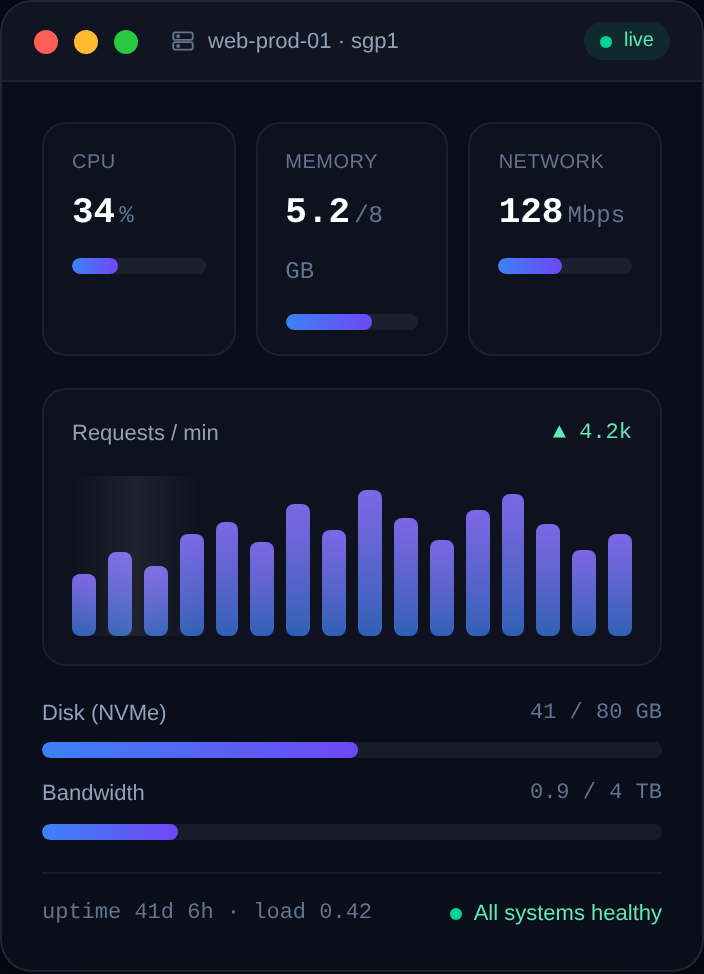
RAM vs CPU: which runs out first?
- RAM caps *how much world and how many entities* fit in memory. Hit the limit and you get crashes or swapping.
- CPU single-thread caps *how smooth the simulation stays*. Hit the limit and you get tick lag even with RAM to spare.
Most survival games hit RAM first as bases grow; most simulation-heavy or high-tick games hit CPU first. Watch both with server resource monitoring.
Squeeze out more headroom
Same box, more players:
- Lower view/simulation distance — often the single biggest win.
- Trim entity limits and clean up abandoned bases/items.
- Reduce heavy mods/plugins; each adds overhead.
- Keep the server updated and restart on a schedule to clear memory — see automating restarts with systemd and cron.
- Reduce lag with targeted tuning, e.g. how to reduce Minecraft server lag.
Settings move the number as much as specs
Two servers on identical hardware can support very different player counts depending on configuration. Before you conclude you need a bigger plan, check whether your settings are working against you:
- View / render / simulation distance is usually the single heaviest setting. Halving it can dramatically raise how many players a box holds.
- Entity and mob limits — abandoned bases, dropped items and mob farms accumulate and eat CPU. Cleaning them up frees real headroom.
- Backup and autosave frequency — saving too often causes periodic stutter; too rarely risks data loss. Find a sensible middle.
- Mods and plugins each add overhead. A lean server holds more players than a heavily-modded one on the same hardware.
The lesson: tuning is free capacity. Wring out the settings before you spend on a bigger plan.
Plan for peak, not average
A common mistake is sizing for your *typical* player count and then getting caught out at peak. Capacity planning should target the busy moments:
- Game launches, events and wipe days bring your highest concurrent load — sizing for a quiet Tuesday guarantees lag on the big night.
- Late-game state matters for survival games: worlds and bases grow, pushing memory well above day-one levels. Size for the mature world.
- Leave headroom. Running a box at 95% of capacity leaves nothing for spikes; aim to sit comfortably below your ceiling so bursts don't tip you over.
The good news is that a VPS resizes quickly, so you can start reasonably and scale up as your community grows rather than over-buying on day one. Monitor RAM and CPU during your busiest sessions and let the data — not guesswork — tell you when it's time for a bigger plan.
Where Nxeon fits
Nxeon's NVMe KVM VPS give you real, non-oversold resources and full root to tune settings — the two things that most affect real player capacity. Browse game server hosting and match RAM to your target count on pricing. If you outgrow a shared game panel, a VPS scales with you.
FAQ
How many players can a 4 GB VPS handle?
Game-dependent. On Minecraft (Paper) roughly 10 players; on Valheim comfortably its ~10-player design target; on Rust or Palworld, 4 GB is too little for a busy server. Match the plan to the game.
Does more RAM mean more players?
Up to a point. RAM caps how much world and how many entities fit, so more RAM raises the ceiling — but if CPU single-thread performance is the limiter, adding RAM alone won't stop tick lag.
Why does my server lag with players to spare on RAM?
That's usually a CPU bottleneck. The game loop can't keep up with the simulation on your cores. Lower view/simulation distance, trim mods, or move to a plan with stronger per-core performance.
How do I know if I need a bigger plan?
Monitor RAM and CPU during peak play. If RAM is near the limit or a core is pinned at 100% while players feel lag, it's time to size up.
Ready to pick a plan? See game server hosting or compare specs on pricing.
Game server hosting
Deploy in seconds, not weekends
Nxeon · Nxeon editorial
★★★★★ Straight-talking guides from the team that runs the servers.