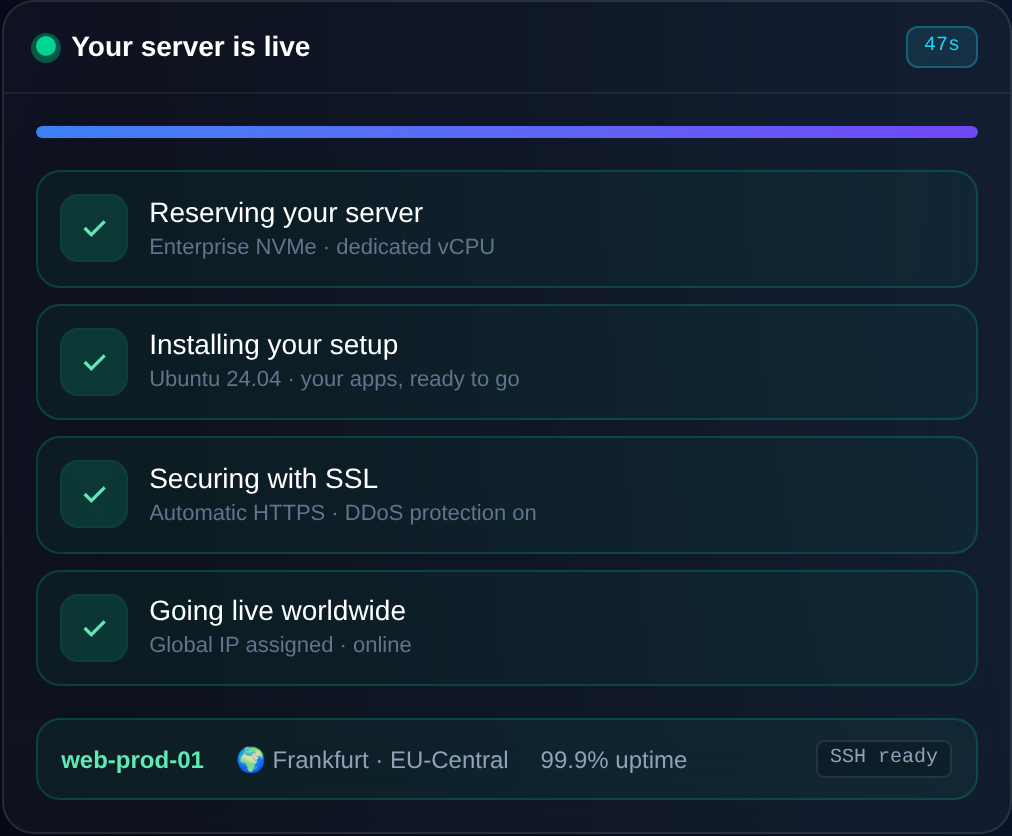
Getting your website live is one DNS record. Here's exactly what to change, why a shared IP is normal, and how HTTPS turns on by itself.
Moving your website onto new hosting sounds scary. It isn't. For most sites it comes down to changing one DNS record — and once you understand what that record does, you'll never be intimidated by it again.
What an A record actually does
An A record maps your domain name (example.com) to an IP address — the numeric address of the server that answers requests for your site. When someone types your domain, their browser asks DNS "where does this live?", DNS hands back the IP from your A record, and the browser connects there.
So "pointing your domain" is literally: *set the A record to the IP your host gave you.*
The steps
- Find your host's IP. In your Nxeon dashboard, open your Web Hosting account — the shared IP address is shown as "point your domain here."
- Log in to wherever your DNS lives. That's usually your domain registrar (where you bought the domain) or a DNS provider like Cloudflare.
- Edit the A record for
@(that's the root of your domain) and set it to the host IP. Add a second A record forwwwpointing to the same IP, or a CNAME forwww→ your root domain. - Save. That's it.
"Wait — everyone shares one IP?"
Yes, and that's completely normal. Almost all shared web hosting puts many sites on one IP address, and it does not affect your site. The server routes each request by the domain name in the request (the Host header), so your site and your neighbor's site are fully separate — separate files, separate databases, separate configuration. They never see each other.
The only thing shared is the IP's *reputation*, which is why good hosts run malware scanning, a web application firewall, and abuse monitoring on the box. If you ever need your own dedicated IP (some compliance or email setups want one), you can add it later.
How long does it take?
DNS changes propagate anywhere from a few minutes to a couple of hours, occasionally longer if your old records had a long "TTL." You can check progress with a free DNS lookup tool — once it returns the new IP worldwide, you're live.
HTTPS turns on by itself
Here's the part people worry about needlessly: you don't have to buy or configure an SSL certificate. The moment your domain resolves to the host, a free certificate is issued and installed automatically, and it renews itself forever. Your visitors get the padlock without you touching a thing.
The short version
Point one A record at your host's IP, wait for DNS, and your site is live with automatic HTTPS. If you're moving an existing site, free migration will bring the files and database across first so nothing breaks during the switch.
Web hosting
Deploy in seconds, not weekends
Nxeon · Nxeon editorial
★★★★★ Straight-talking guides from the team that runs the servers.