Deploying an Express, Next.js or NestJS app? Here's how to choose a VPS that runs Node reliably in production — sizing, process management and the features that matter.
Node.js apps are lightweight to start but punishing if you under-provision — a memory leak or a traffic spike can take the whole process down. This guide covers how to pick a VPS that runs your Express, Next.js or NestJS app reliably in production, with real commands to keep it alive.
How Node uses resources
Node runs your app on a single main thread with an event loop, offloading I/O asynchronously. That shapes what you should buy:
- CPU: single-thread speed matters for request handling; extra cores help if you run multiple processes with clustering or PM2.
- RAM: the usual bottleneck. Node's V8 heap plus your dependencies add up. A small API runs in 1 GB; a Next.js app doing SSR wants 2 GB; heavier apps or several services want 4 GB+.
- NVMe: speeds up
npm install, builds and any local database.
Size it honestly
Defensible starting points:
- 1 GB RAM: a small Express/Fastify API or a Discord bot.
- 2 GB RAM: a Next.js/Nuxt app with SSR, or a couple of small services.
- 4 GB+ RAM: multiple services, a bundled database, or heavier build steps.
Watch the default V8 heap limit on small boxes — you can raise it if needed:
node --max-old-space-size=1536 server.jsRun it like production
Never run node app.js in a bare terminal for production. Use a process manager so it restarts on crash and boot:
npm install -g pm2
pm2 start app.js --name my-api
pm2 startup
pm2 save
Put Nginx in front as a reverse proxy for TLS and to serve on port 443. Our full walkthrough covers it: how to deploy a Node.js app on a VPS, and for the React framework specifically, how to deploy a Next.js app on a VPS.
Docker is a great fit too
Many teams ship Node in containers for reproducible deploys. A VPS with root lets you run Docker freely — see how to run Docker on a VPS. If you're comparing container hosting, our best VPS for Docker guide goes deeper.
Watch memory and the event loop
Node's biggest production risks aren't traffic — they're memory leaks and a blocked event loop. Because your app runs on a single main thread, one slow synchronous operation stalls every request. Two habits keep you ahead of trouble:
- Monitor memory over time. A steadily climbing heap usually means a leak — an accumulating cache, unclosed connections, or growing arrays. PM2 shows per-process memory, and you can set it to restart a process if it crosses a threshold:
pm2 start app.js --max-memory-restart 500M. - Keep the event loop free. Offload CPU-heavy work (image processing, large JSON, crypto) to worker threads or a separate service so it doesn't block request handling.
Pair this with proper logging and server resource monitoring so you catch problems before users do.
Zero-downtime deploys and clustering
Once your app is live, you'll want to ship updates without dropping requests, and use every core you're paying for:
- Clustering. A single Node process uses one core. PM2's cluster mode forks one worker per core and load-balances across them:
pm2 start app.js -i max. On a multi-core VPS this multiplies throughput for CPU-bound routes. - Graceful reloads.
pm2 reload apprestarts workers one at a time, so there's no downtime window during a deploy. - Environment config. Keep secrets and settings in environment variables, not hard-coded in your source, and never commit them to a public repository.
For a repeatable release flow, many teams wire up automated deploys so that pushing to a branch builds and ships the app, and use a reverse proxy like Nginx for TLS and to route requests. With full root on a VPS, you assemble exactly the pipeline you want rather than working around a platform's limits — see how to deploy a Node.js app on a VPS for a concrete end-to-end example.
Where Nxeon fits
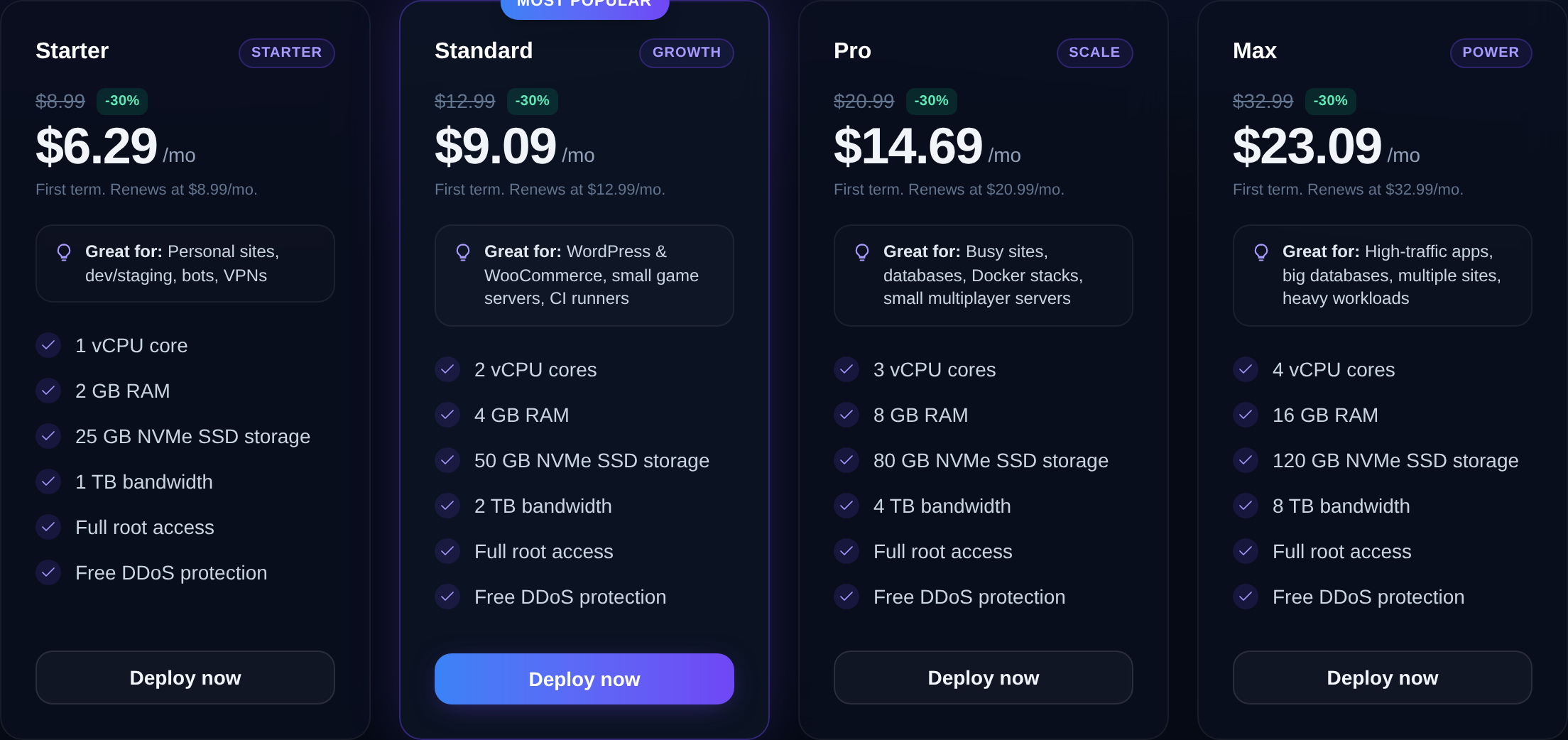
Nxeon gives you NVMe KVM VPS with full root, so you can run any Node version, PM2 or Docker, and a reverse proxy exactly how you like. There's purpose-built Node.js hosting and a developers page with the tooling on offer. Compare plans on pricing to match RAM to your app.
Buying checklist
- 1–2 GB for most single apps; 4 GB+ for multiple services.
- Insist on NVMe for fast installs and builds.
- Confirm full root so you can install any Node version and Docker.
- Plan for a process manager and reverse proxy from day one.
FAQ
How much RAM does a Node.js app need?
A small API runs comfortably in 1 GB. A Next.js app doing server-side rendering is happier with 2 GB, and multiple services or heavy builds want 4 GB or more. Memory is usually the first thing you'll run out of.
Should I use PM2 or Docker for Node in production?
Both work well. PM2 is simple and gives you restarts, clustering and logs. Docker gives reproducible environments and easier multi-service deploys. On a VPS with full root you can use either.
Do I need Nginx in front of Node?
It's strongly recommended. Nginx handles TLS termination, serves on port 443, and can load-balance multiple Node processes — keeping your app process focused on application logic.
Can I run several Node apps on one VPS?
Yes. Use PM2 or Docker to run multiple processes and Nginx to route by domain or path. Just size the RAM for the combined load.
Deploying soon? Start with Node.js hosting or explore the developers page.
Cloud VPS hosting
Deploy in seconds, not weekends
Nxeon · Nxeon editorial
★★★★★ Straight-talking guides from the team that runs the servers.