Running containers in production? Here's how to choose a VPS that handles Docker well — kernel and virtualization requirements, sizing, and storage that won't bite you.
Docker turns "works on my machine" into "works everywhere", but only if your VPS can actually run it well. Some cheap virtualization types can't run modern Docker cleanly at all. This guide covers what to look for and how to size a box for containers.
Virtualization matters more than anything
This is the single most important buying decision for Docker:
- KVM (full virtualization): runs its own kernel, so Docker, custom kernels and nested features all work normally. This is what you want.
- OpenVZ / container-based VPS: shares the host kernel and often restricts the features Docker relies on. Avoid it for serious container work.
If you're unsure of the difference, our explainer on KVM vs OpenVZ virtualization breaks it down. The short version: buy KVM.
Sizing for containers
Containers are lightweight, but the *sum* of what you run isn't. Plan by workload:
- 2 GB RAM: a few small containers — an app, a database, a reverse proxy.
- 4 GB RAM: a typical multi-container stack (app + DB + cache + proxy) via Compose.
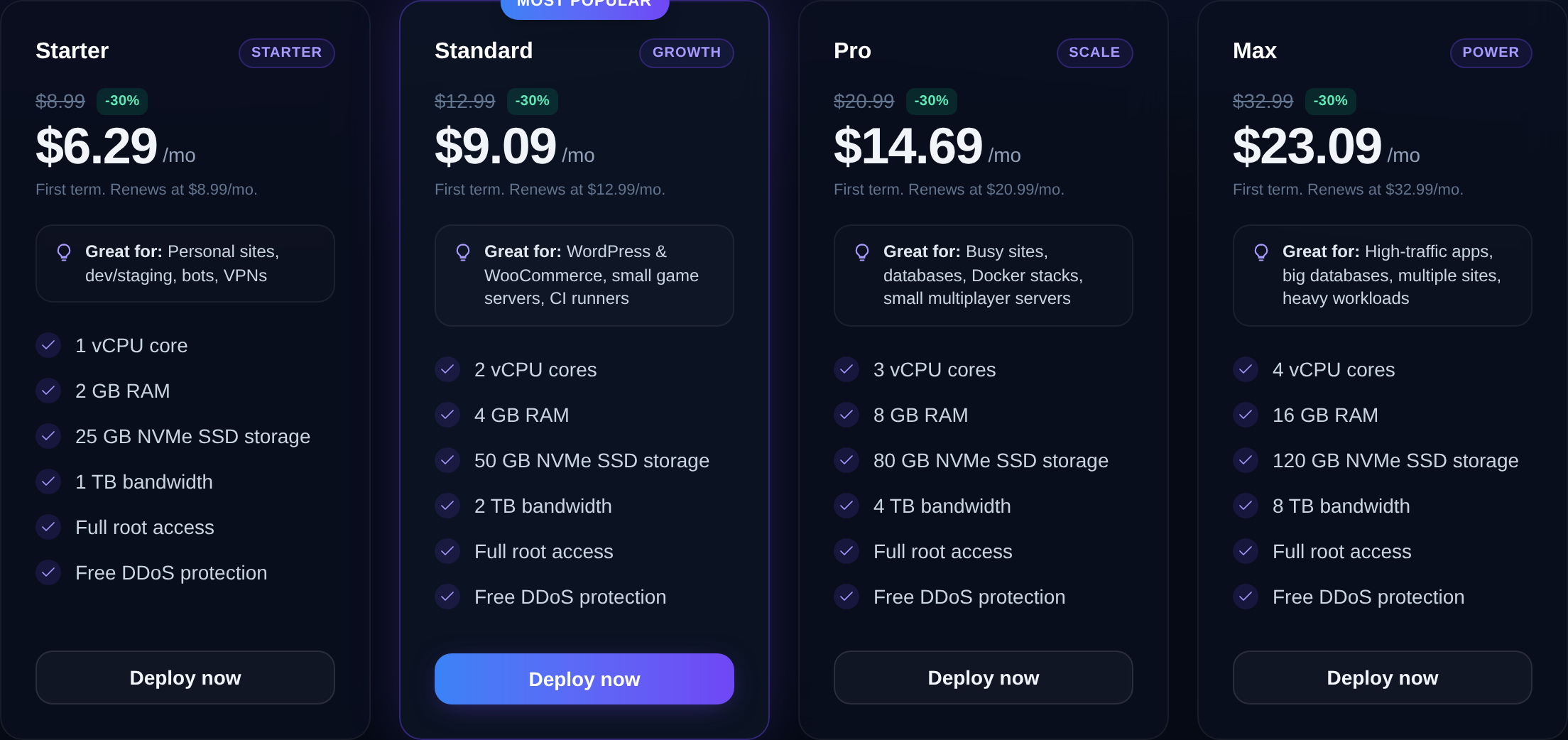
- 8 GB+ RAM: several stacks, or memory-hungry services like databases and search.
Storage is the sneaky one. Images, layers, volumes and logs accumulate fast. Budget plenty of NVMe and prune regularly:
docker system prune -a --volumesGet Docker running
Install from Docker's official repository, not the outdated distro package:
curl -fsSL https://get.docker.com | sudo sh
sudo usermod -aG docker $USER
Then a Compose stack is a single file and one command. Our full guide covers it end to end: how to run Docker on a VPS.
Networking, ports and TLS
Publish container ports deliberately and firewall the rest. A reverse proxy (Nginx, Caddy or Traefik) in front handles TLS for all your containers at once — see set up Caddy for automatic HTTPS. Running Node or other apps in containers? Our best VPS for Node.js apps guide pairs well with this one.
Compose is where Docker gets practical
Running single containers by hand gets old fast. Docker Compose describes a whole stack — app, database, cache, reverse proxy — in one docker-compose.yml file, and brings it up with one command:
docker compose up -dThat single file becomes your infrastructure-as-code: version it in git, and any VPS can recreate the exact stack. It also makes upgrades painless — change an image tag, run docker compose up -d again, and only the changed service is recreated. For a full walkthrough, see how to run Docker on a VPS.
Keep it secure and observable
Containers don't secure themselves. A few essentials turn a Docker VPS from a liability into a solid platform:
- Don't run containers as root where you can avoid it, and never expose the Docker socket to untrusted containers.
- Firewall deliberately. Only publish the ports you actually need; keep databases bound to the internal network, not the public interface.
- Put a reverse proxy in front (Caddy, Traefik or Nginx) to terminate TLS for every service at once rather than baking certificates into each container — see set up Caddy for automatic HTTPS.
- Watch resource use. A runaway container can starve the host; set memory limits in Compose (
mem_limit) and monitor withdocker statsand server resource monitoring. - Manage it visually if you prefer a UI — a tool like Portainer gives you a dashboard over your containers.
Because a KVM VPS gives you full root and a real kernel, all of this works exactly as it does on any Linux host — no platform quirks to fight.
Where Nxeon fits
Nxeon VPS plans are KVM with full root and NVMe storage — the right foundation for Docker, with no kernel restrictions to trip over. There's dedicated Docker hosting and clear pricing so you can size RAM and disk to your stack. Developers can see the wider toolset on the developers page.
Buying checklist
- KVM virtualization — non-negotiable for real Docker.
- NVMe with generous disk for images and volumes.
- 4 GB RAM as a sensible baseline for a multi-container stack.
- Full root to install Docker from the official repo.
FAQ
Can I run Docker on any VPS?
Not reliably. KVM VPS run their own kernel and support Docker fully. OpenVZ or container-based VPS share the host kernel and often can't run modern Docker properly — always choose KVM for containers.
How much RAM do I need for Docker?
It depends on what you run. A small multi-container stack (app, database, cache, proxy) is comfortable on 4 GB. Add more for extra stacks or memory-hungry services like databases.
Why is my Docker VPS running out of disk?
Unused images, dangling layers, stopped containers and volumes pile up. Run docker system prune -a --volumes periodically and provision generous NVMe storage from the start.
Do I need Docker Compose?
Not required, but highly recommended. Compose defines a multi-container stack in one YAML file and brings it up with a single command, which is far easier than managing containers by hand.
Ready to containerize? See Docker hosting or compare KVM plans on pricing.
Cloud VPS hosting
Deploy in seconds, not weekends
Nxeon · Nxeon editorial
★★★★★ Straight-talking guides from the team that runs the servers.