
The virtualization type behind your VPS quietly decides what you can run and how well it performs. Here's a clear comparison of KVM and OpenVZ, and why it matters.
When you buy a VPS, the virtualization type behind it quietly decides what you can run, how isolated you are, and whether your "dedicated" resources are truly yours. The two you'll see most are KVM and OpenVZ. Here's a plain comparison and why it matters for your buying decision.
KVM: full virtualization
KVM (Kernel-based Virtual Machine) creates a fully virtualized machine. Each VPS runs its own kernel, as if it were a separate physical computer.
That means:
- You can run your own kernel, load custom modules, and use features like Docker cleanly.
- Resources (RAM, CPU) are genuinely allocated to your instance.
- Strong isolation from neighbours on the same host.
- You can run any OS — various Linux distros, and even Windows.
The trade-off is slightly more overhead than OpenVZ, but on modern hardware it's negligible.
OpenVZ: container-based virtualization
OpenVZ is container-based. All VPS on a host share the host's kernel, with the host carving out isolated userspace environments.
That means:
- Lower overhead and higher density — which is why it's cheap.
- No custom kernel: you can't run a different kernel or some kernel-dependent features.
- Weaker isolation: you're more exposed to a busy or oversold host.
- Resource "bursting" and overselling are common, so guaranteed resources are often less guaranteed in practice.
Why it matters for what you run
- Docker/containers: KVM runs Docker cleanly; OpenVZ often restricts the features it needs. If containers are on your roadmap, this alone settles it — see best VPS for Docker.
- Custom kernel modules, VPNs, some networking: need a real kernel — KVM.
- Overselling risk: OpenVZ hosts more often oversell, so your performance can suffer from neighbours.
For sizing your box regardless of type, see how to choose a VPS plan, and for the bigger picture, what is a VPS.
Which should you choose?
For almost everyone, KVM is the safer choice: real kernel, genuine resource guarantees, full flexibility, and no surprises with Docker or custom software. OpenVZ can be fine for very light, simple workloads where the low price wins — but you accept its limitations. When comparing budget plans, our best cheap VPS hosting guide explains why KVM is worth insisting on even on a budget.
Why "guaranteed" resources aren't always guaranteed
One of the most practical differences between the two comes down to overselling. Both KVM and OpenVZ hosts *can* oversell, but the container model makes it especially tempting and especially impactful:
- On OpenVZ, memory and CPU can be "burstable" — advertised limits you can sometimes exceed, which sounds generous but means your neighbours can too. When several instances burst at once, everyone's performance suffers, and you may hit hard limits you didn't expect.
- On KVM, RAM is allocated to your virtual machine as if it were physical. It's genuinely yours; a neighbour can't reclaim it. CPU can still be contended if a host is oversold, but the isolation is stronger and more predictable.
This is why two plans with identical "2 GB RAM, 2 vCPU" specs can perform very differently — the virtualization model and the host's overselling policy matter as much as the numbers.
What this means when you're buying
Turn the theory into a simple buying rule:
- Choose KVM unless you have a specific reason not to. It runs a real kernel, gives you genuine resource guarantees, supports Docker and VPNs, and behaves like a real server.
- Consider OpenVZ only for very light, simple, price-sensitive workloads where you understand and accept the limitations — a small static site or a simple service, never anything needing a custom kernel or containers.
- Always confirm the virtualization type on the plan page before buying; a reputable host states it clearly. If it's hidden, treat that as a warning sign.
- Pair the right virtualization with the right specs — sizing help is in how to choose a VPS plan.
Get the virtualization right and the rest of your VPS decisions get easier, because you're building on a predictable foundation.
Where Nxeon fits
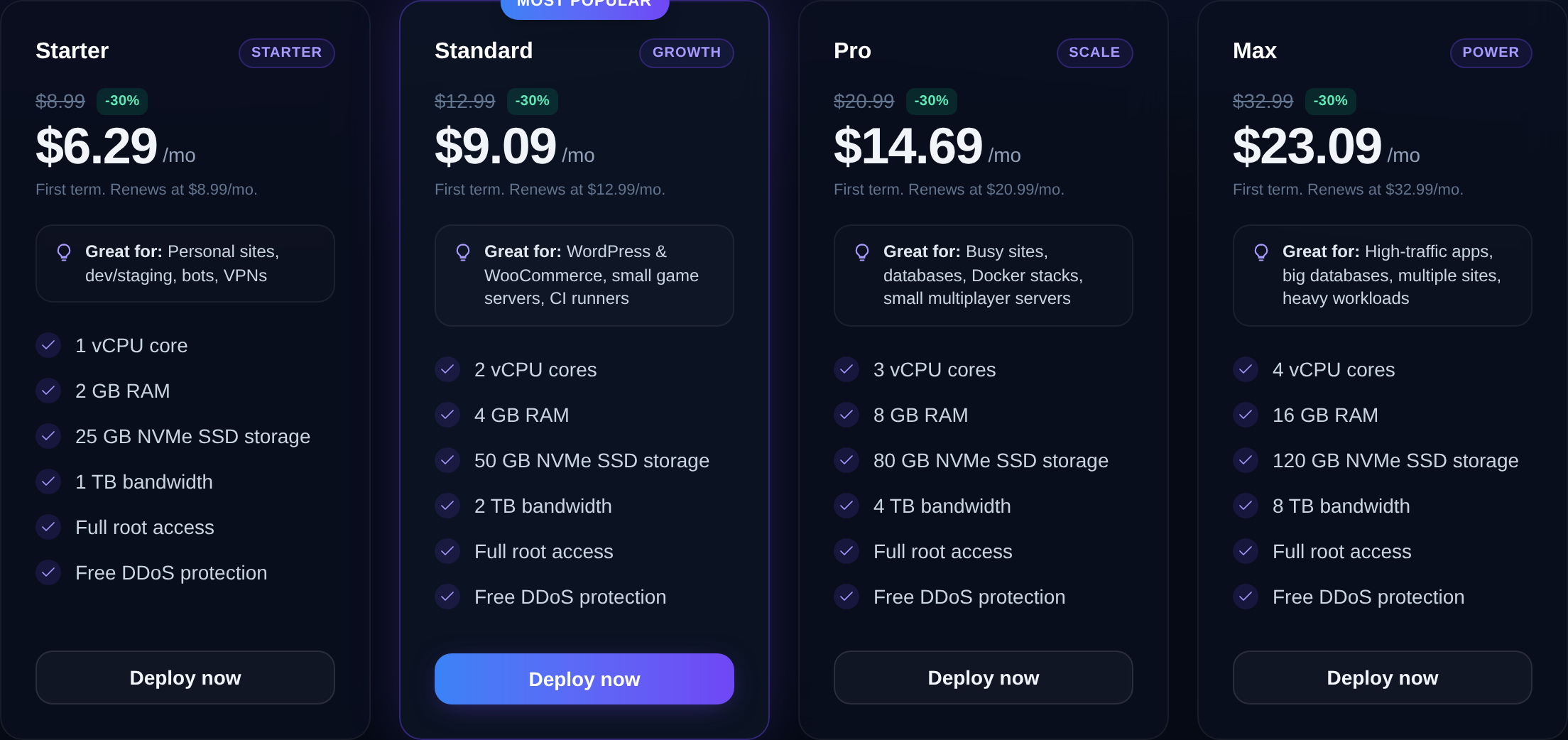
Nxeon VPS plans are KVM with NVMe storage and full root — so you get a real kernel, genuine dedicated resources, and the freedom to run Docker, VPNs and custom software without hitting container-host walls. Explore the VPS overview or compare plans on pricing.
FAQ
Is KVM better than OpenVZ?
For most use cases, yes. KVM gives each VPS its own kernel, genuine resource guarantees and full flexibility — including clean Docker support. OpenVZ is cheaper and lighter but shares the host kernel and is more often oversold.
Can I run Docker on OpenVZ?
Often not reliably. Docker relies on kernel features that OpenVZ, which shares the host kernel, frequently restricts. KVM runs its own kernel and supports Docker fully, so choose KVM for containers.
Why is OpenVZ cheaper?
Container-based virtualization packs more instances onto each host with less overhead, so providers can sell it cheaply — sometimes by overselling resources. The savings come with weaker isolation and less guaranteed performance.
How do I know which virtualization a VPS uses?
Reputable hosts state it on the plan page. If it isn't listed, ask before buying. For flexibility and predictable performance, look for KVM.
Want a real kernel and genuine resources? See the VPS overview or compare KVM plans on pricing.
Cloud VPS hosting
Deploy in seconds, not weekends
Nxeon · Nxeon editorial
★★★★★ Straight-talking guides from the team that runs the servers.