
Cheap and reliable aren't opposites — if you know what to check. Here's how to spot genuine value in a budget VPS and avoid the traps that make cheap hosting expensive.
"Cheap VPS" gets a bad reputation, but a low price and good hosting aren't mutually exclusive — you just have to know what separates real value from a false economy. This guide shows what to check so a budget VPS saves you money instead of costing you in downtime and frustration.
What "cheap" should still include
A genuinely good budget VPS doesn't skimp on the fundamentals:
- NVMe storage, not slow spinning disks or old SATA SSDs. This is the single biggest real-world speed difference.
- KVM virtualization, so you get a real kernel, run Docker, and aren't boxed in by an oversold container host.
- Full root access — it's a VPS; you should own it completely.
- Honest bandwidth — a clear transfer allowance, not vague "unlimited" that gets throttled.
If a plan cuts these to hit a price, that's where cheap becomes expensive.
The traps that make cheap hosting costly
- Oversold nodes: too many customers per server means your "dedicated" resources aren't. Look for hosts that don't cram nodes.
- Old hardware: ancient CPUs and spinning disks are why some bargain VPS feel sluggish.
- Surprise renewal pricing: a low intro rate that triples on renewal isn't cheap.
- No backups or snapshots: losing data costs far more than you saved.
Our honest look at how much web hosting costs puts realistic numbers on this.
Right-size instead of over-buying
The cheapest *effective* plan is the one that matches your workload. A small site, bot or API runs happily on an entry plan; you don't need 8 GB for a brochure site. Our how to choose a VPS plan guide walks through sizing CPU, RAM, storage and bandwidth so you buy exactly what you need.
Cheap vs value: they're different
"Cheapest" and "best value" aren't the same. Value is performance-per-dollar with the fundamentals intact. A slightly higher price with NVMe, KVM and a host that doesn't oversell often beats a rock-bottom plan that lags. If you're a developer, our best VPS for developers guide covers what actually matters.
How to actually compare budget plans
Two plans at the same price can differ wildly in real value. When you're comparing, line them up on the things that affect your experience, not just the headline RAM figure:
- Storage type and amount. NVMe vs SATA SSD is a large real-world speed gap. A plan with more RAM but a slow disk can feel slower than a leaner one with NVMe.
- CPU generation and allocation. "2 vCPU" means little without knowing the chip and whether cores are dedicated or heavily shared. Modern, lightly-shared cores beat more oversold ones.
- Bandwidth allowance, stated as a real number, not "unlimited" with hidden throttling.
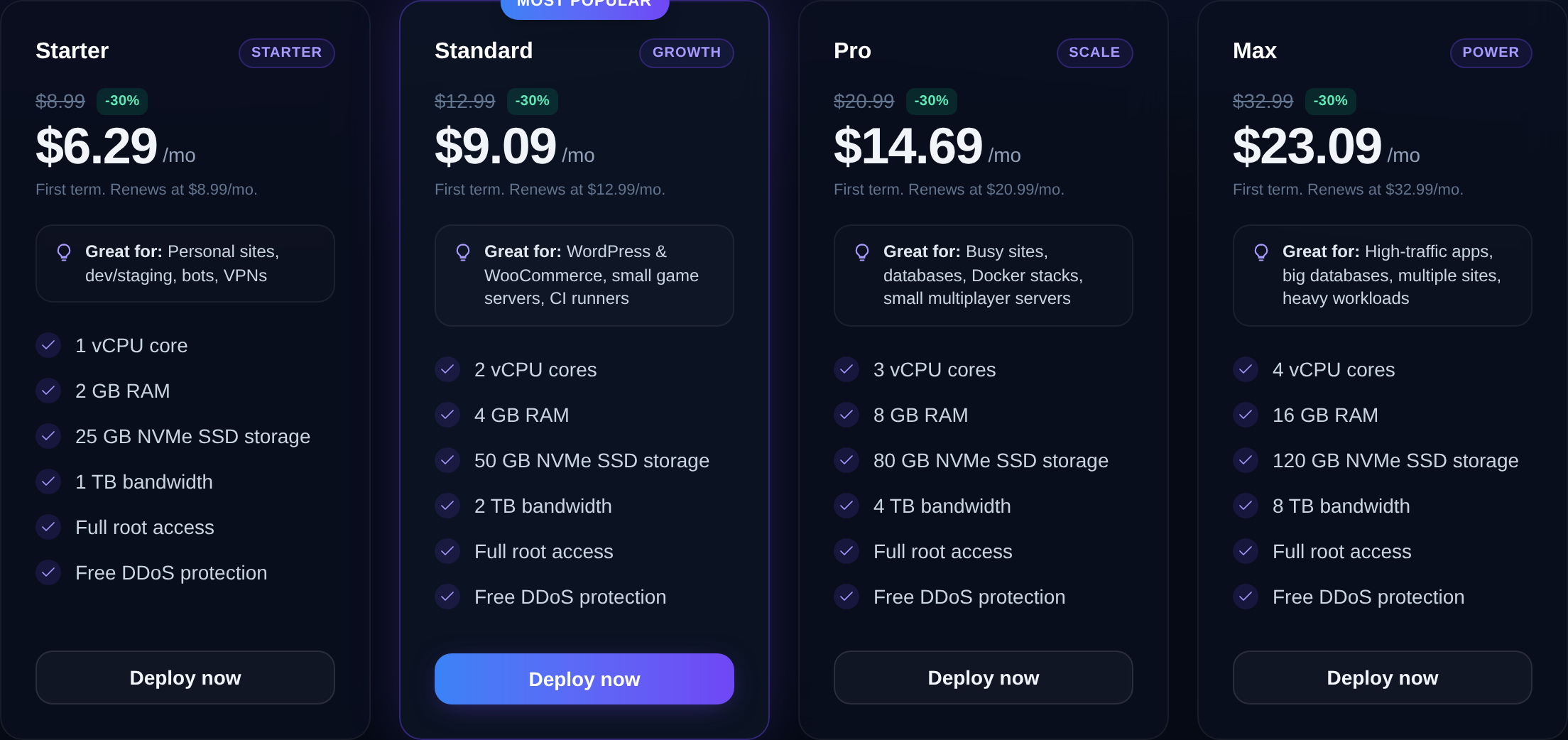
- What's included: backups, snapshots, DDoS protection, an IPv4 address, and whether the control panel and migration help cost extra.
- Renewal price, which is where "cheap" plans often stop being cheap.
Put those side by side and the genuinely good-value plan usually stands out — it's rarely the absolute lowest sticker price.
Cheap doesn't have to mean risky
The fear with budget hosting is unreliability, but you can de-risk it:
- Right-size so you're not starved. An under-provisioned box lags no matter how good the host — match the plan to your workload using how to choose a VPS plan.
- Keep your own backups. Even if the host offers them, an off-server backup means a failure or mistake never costs you your data — see how to set up automated backups on a VPS.
- Start with a trial or small plan and scale up once you've confirmed performance, rather than committing big up front. A good VPS resizes easily.
- Secure it properly from day one so "cheap" never means "compromised" — the securing your first Linux VPS checklist takes minutes.
Done this way, a budget VPS is a smart economy, not a gamble.
Where Nxeon fits
Nxeon focuses on real value: NVMe KVM VPS with full root, one-click images and free migration, at honest prices that don't balloon on renewal. See the best value VPS, cheap VPS hosting and affordable VPS hosting pages, or compare everything on pricing. Want to trial first? There's a free VPS option.
Buying checklist
- NVMe + KVM + full root are non-negotiable, even on a budget.
- Check renewal pricing, not just the intro rate.
- Confirm honest bandwidth and available backups/snapshots.
- Right-size the plan to your workload rather than over-buying.
FAQ
Is cheap VPS hosting reliable?
It can be, if the fundamentals are intact: NVMe storage, KVM virtualization, full root and a host that doesn't oversell its nodes. Cheap becomes unreliable only when providers cut those corners.
What's the difference between cheap and best-value VPS?
Cheapest is simply the lowest price; best value is the most performance per dollar with the essentials kept. A slightly pricier NVMe/KVM plan often outperforms a rock-bottom one that lags.
How do I avoid getting a slow budget VPS?
Insist on NVMe storage and modern CPUs, choose KVM over oversold container hosting, and check reviews for noisy-neighbour complaints. Right-size the plan so you're not starved of RAM.
Do cheap VPS plans include backups?
Not always — it varies by host. Check whether snapshots or backups are included or extra, because recovering from data loss costs far more than the small backup fee.
Looking for real value? Compare the best-value VPS plans or start with a free VPS.
Cloud VPS hosting
Deploy in seconds, not weekends
Nxeon · Nxeon editorial
★★★★★ Straight-talking guides from the team that runs the servers.