
Stop guessing at specs. This practical guide walks through sizing CPU, RAM, storage and bandwidth for your workload so you buy the right VPS the first time.
Choosing a VPS plan feels like guesswork when every host lists the same four numbers. This guide demystifies CPU, RAM, storage and bandwidth so you can match a plan to your actual workload — no over-buying, no getting caught short.
Start with your workload, not the specs
The right plan depends entirely on what you're running. Roughly:
- A small website, blog or bot: entry-level — 1–2 GB RAM.
- A busy WordPress site or web app: mid-tier — 2–4 GB RAM.
- A database-heavy app, WooCommerce, or several services: 4–8 GB+.
- Game servers: vary widely by game (Minecraft vs Rust vs Palworld).
Everything below refines that starting point.
RAM: usually the first thing you run out of
RAM caps how much your server can do at once. Too little means swapping, slowdowns or crashes; too much is wasted money. Size it to your app plus the OS (leave ~1 GB headroom for the system). Our how much RAM does a VPS need guide goes deeper. If you're tight on RAM, tuning swap and OOM behaviour helps small plans cope.
CPU: cores vs clock speed
Two things matter, and which one depends on your workload:
- Single-thread performance (clock speed): critical for game servers, PHP rendering and anything single-threaded.
- Core count: helps web apps that run multiple worker processes, concurrent requests, and multiple services.
Don't fixate on core count alone — a few fast cores often beat many slow ones for real work.
Storage: size *and* type
Two decisions here:
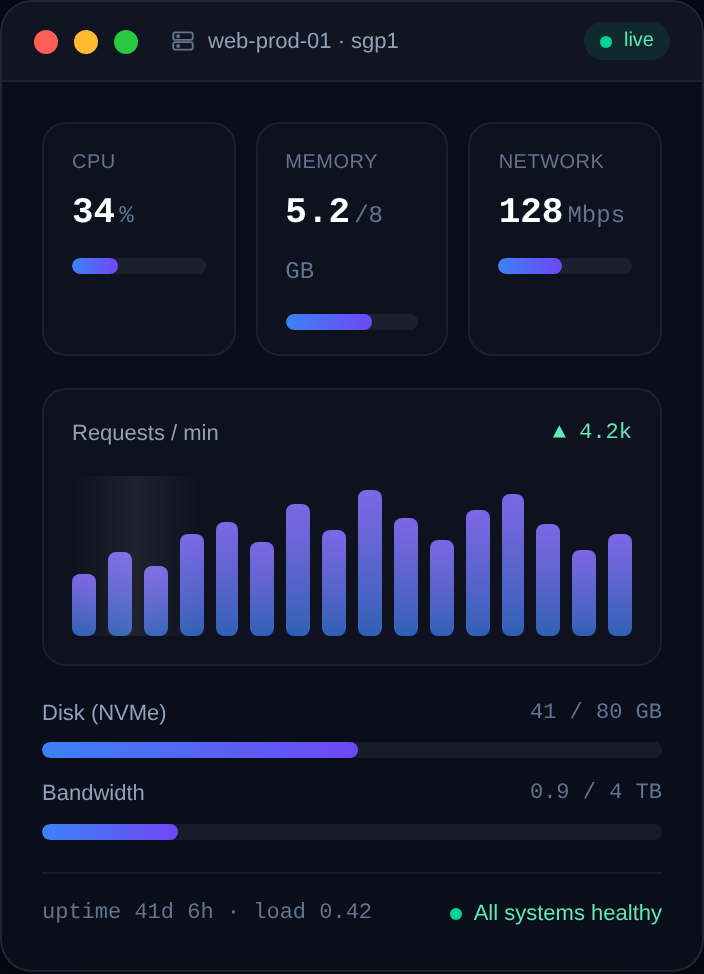
- Type: insist on NVMe SSD. It's dramatically faster than SATA SSD or spinning disks for databases, builds and page loads — the biggest real-world speed factor.
- Amount: the OS and app need room, plus logs, media and backups. Don't run near-full; leave headroom. Need more? Block storage volumes let you add space without resizing the whole plan.
Bandwidth: read the fine print
Bandwidth (data transfer) is where marketing gets vague:
- Look for a clear monthly transfer allowance, not undefined "unlimited".
- Estimate your usage: page weight × visitors, or player count × session length for game servers.
- Most small sites use far less than they fear; media-heavy sites and busy game servers use more.
Put it together and leave room to grow
Pick the plan that fits your workload today with a little headroom, knowing a good VPS resizes easily when you grow. It's better to start right-sized and scale up than to over-buy on day one. For role-specific sizing, see best VPS for WordPress, best VPS for Node.js apps and best VPS for developers.
Don't forget the specs that aren't in the four numbers
CPU, RAM, storage and bandwidth get the headlines, but a few other factors quietly shape your experience — check them before you buy:
- Virtualization type. KVM gives you a real kernel and genuine resource guarantees; avoid oversold container hosting for anything serious. See KVM vs OpenVZ virtualization explained.
- Data-centre location. Latency is set by distance. Pick a region near your users (or players) — no amount of CPU fixes a slow round-trip.
- Backups and snapshots. Whether they're included, extra, or absent changes both your safety and your real cost.
- IPv4 address, DDoS protection and the control panel — small line items that add up and sometimes carry extra fees.
- Ease of resizing. How simple is it to scale up later? A good VPS makes this a few-minute operation, which lets you start smaller with confidence.
A cheap plan that skimps on these can cost more in practice than a slightly pricier one that includes them.
A simple sizing method
If you want a repeatable way to land on the right plan, work through it in this order:
- Identify your workload and its known appetite — a blog, a busy app, a store, a specific game. Start from a realistic RAM figure for that workload.
- Add headroom — roughly 1 GB for the OS, plus a margin for spikes, so you're not running at the edge.
- Match CPU to the type of work — high clock for single-threaded workloads like game servers and PHP rendering; more cores for concurrent, multi-process apps.
- Size storage for the OS, app, logs, media and backups, insisting on NVMe — and remember you can often add block storage later without resizing everything.
- Estimate bandwidth from your traffic and confirm the allowance is a real number.
- Pick the plan that fits today with a little room, knowing you can resize as you grow.
Follow that and you'll rarely over- or under-buy. For role-specific numbers, our guides on WordPress, Node.js and Docker give concrete starting points.
Where Nxeon fits
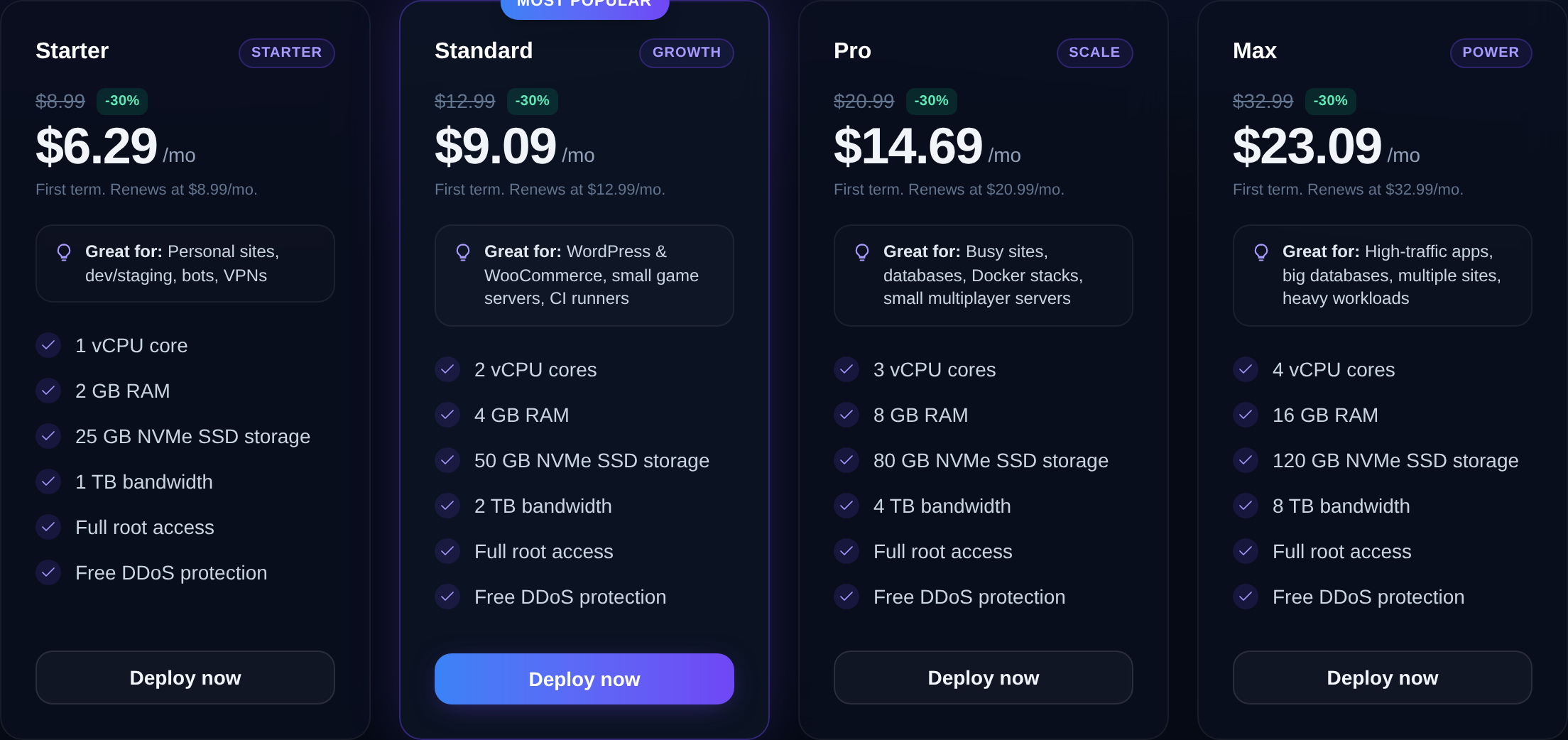
Nxeon's plans use NVMe storage and KVM virtualization with clear, honest specs — so the four numbers actually mean what they say. Full root lets you resize and add block storage as you grow. Compare plans side by side on pricing or read the VPS overview.
FAQ
How much RAM do I need for a VPS?
Match it to your workload: 1–2 GB for a small site or bot, 2–4 GB for a busy WordPress site or web app, 4–8 GB+ for database-heavy apps. Always leave about 1 GB of headroom for the operating system.
Is more CPU cores or higher clock speed better?
It depends. Single-threaded workloads — game servers, PHP rendering — want high clock speed. Apps that run many worker processes or concurrent requests benefit from more cores. Don't judge by core count alone.
How much storage does a VPS need?
Enough for the OS, your app, logs, media and backups, with headroom so you're not running near-full. NVMe type matters as much as the amount — it's the biggest real-world speed factor.
What happens if I choose the wrong plan?
A good VPS resizes easily, so you can scale up (or sometimes down) as your needs change. Start right-sized for today with a little headroom rather than over-buying up front.
Ready to size your plan? Compare specs on pricing or read the VPS overview.
Cloud VPS hosting
Deploy in seconds, not weekends
Nxeon · Nxeon editorial
★★★★★ Straight-talking guides from the team that runs the servers.