From a Flask API to a Django app or a data pipeline, here's how to choose a VPS that runs Python reliably in production — sizing, WSGI servers and deployment tips.
Python powers everything from tiny Flask APIs to heavy Django apps and long-running data jobs — and each has different hosting needs. This guide helps you pick a VPS that runs your Python project reliably, with the right server setup so it survives real traffic.
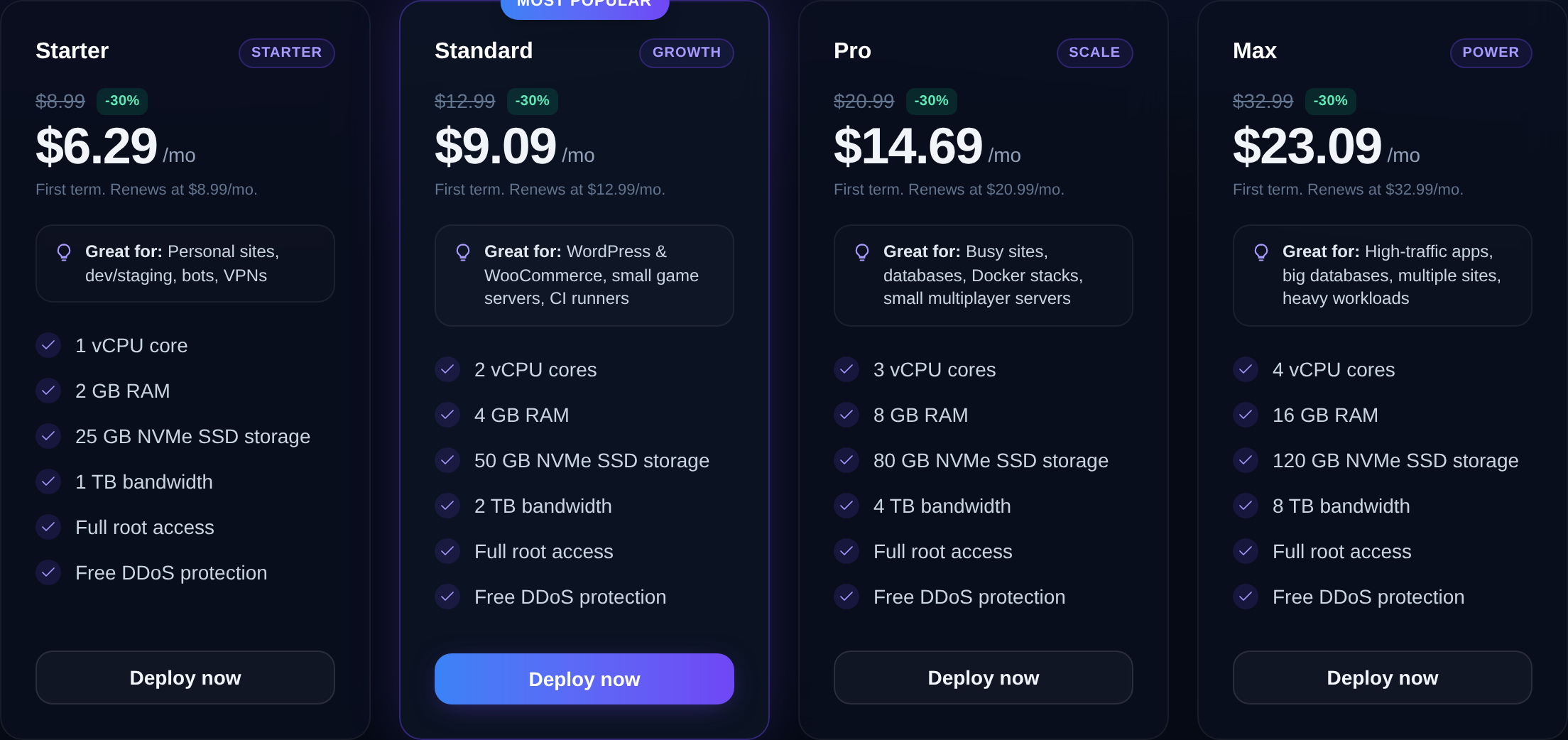
Match the VPS to the workload
Python's footprint varies enormously:
- A Flask/FastAPI microservice: modest — 1 GB RAM is often enough.
- A Django app with a database: 2 GB is a comfortable starting point.
- Data processing, ML inference or Celery workers: CPU and RAM hungry — 4 GB+ and strong cores.
Because CPython uses a Global Interpreter Lock, one process runs Python bytecode on one core at a time. You scale by running multiple worker processes — which means more cores genuinely help web apps, unlike single-threaded runtimes.
Use a real application server
Never expose Flask or Django's development server to the internet. Use a production WSGI/ASGI server with several workers behind Nginx.
For a WSGI app with Gunicorn:
pip install gunicorn
gunicorn --workers 3 --bind 127.0.0.1:8000 myapp:app
A common rule of thumb is (2 × cores) + 1 workers. For async frameworks like FastAPI, use Uvicorn workers instead. Put Nginx in front for TLS and static files.
Isolate with virtual environments
Keep each project's dependencies clean:
python3 -m venv .venv
source .venv/bin/activate
pip install -r requirements.txt
Combine that with a systemd service or a process manager so your app restarts on crash and boot.
Containers and background jobs
Many Python teams ship in Docker for reproducible builds — a KVM VPS handles that cleanly, as covered in how to run Docker on a VPS and our best VPS for Docker guide. For scheduled jobs and workers, pair Celery or cron with a process manager and monitor resources with how to monitor server resources on Linux.
Keep environments clean and reproducible
Python's dependency management can get messy fast, especially when several projects share a server. Discipline here saves real pain:
- One virtual environment per project. Never
pip installinto the system Python — it risks breaking OS tools that depend on it. A per-project.venvkeeps dependencies isolated. - Pin your dependencies. Commit a
requirements.txt(or use a lockfile with Poetry/uv) so the versions you tested are the versions that deploy.pip freeze > requirements.txtcaptures the current set. - Match your local Python version to the server's to avoid subtle behaviour differences.
Many teams take this further with Docker for fully reproducible builds — a KVM VPS runs it cleanly, as covered in how to run Docker on a VPS.
Run it as a managed service
For production, your app should start on boot and restart on crash — not depend on you leaving a terminal open. A systemd service is the clean way to do this on Linux. It supervises your Gunicorn/Uvicorn process, restarts it if it dies, and captures logs to the journal:
[Service]
User=www-data
WorkingDirectory=/var/www/myapp
ExecStart=/var/www/myapp/.venv/bin/gunicorn --workers 3 --bind 127.0.0.1:8000 myapp:app
Restart=always
Enable it with sudo systemctl enable --now myapp and check logs with journalctl -u myapp. This keeps the app running across crashes and reboots with no manual intervention, and centralises its logs where you can find them. Scheduled jobs pair well with cron, and background task queues like Celery run as their own systemd services alongside the web app — all comfortably on one VPS with room to spare. For fully reproducible builds, many Python teams containerise instead — see how to run Docker on a VPS.
Where Nxeon fits
Nxeon VPS plans give you NVMe storage, modern multi-core CPUs and full root — so you control the Python version, run as many Gunicorn/Uvicorn workers as you need, and add a database or Docker freely. The developers page shows the toolset, and pricing lets you match cores and RAM to your project.
Buying checklist
- 1 GB for a microservice, 2 GB for Django, 4 GB+ for data/ML work.
- Multiple cores genuinely help — you scale with worker processes.
- NVMe for fast installs, builds and databases.
- Full root to install any Python version and system libraries.
FAQ
How much RAM does a Django app need on a VPS?
A typical Django app with a database is comfortable on 2 GB to start. Heavy traffic, many Gunicorn workers, or in-process caching push you toward 4 GB and beyond.
Do more CPU cores help Python web apps?
Yes. Because of the GIL, one process runs on one core at a time, so you scale by running multiple worker processes — and more cores let you run more workers to handle concurrent requests.
What server should I use for Django or Flask in production?
Use Gunicorn (WSGI) or Uvicorn (ASGI) with several workers, behind Nginx for TLS and static files. Never expose the built-in development server to the internet.
Can I run background workers and cron jobs on the same VPS?
Yes. Full root lets you run Celery workers, cron jobs and your web app together. Just size RAM and CPU for the combined load and monitor usage.
Building in Python? Explore the developers page or compare plans on pricing.
Cloud VPS hosting
Deploy in seconds, not weekends
Nxeon · Nxeon editorial
★★★★★ Straight-talking guides from the team that runs the servers.