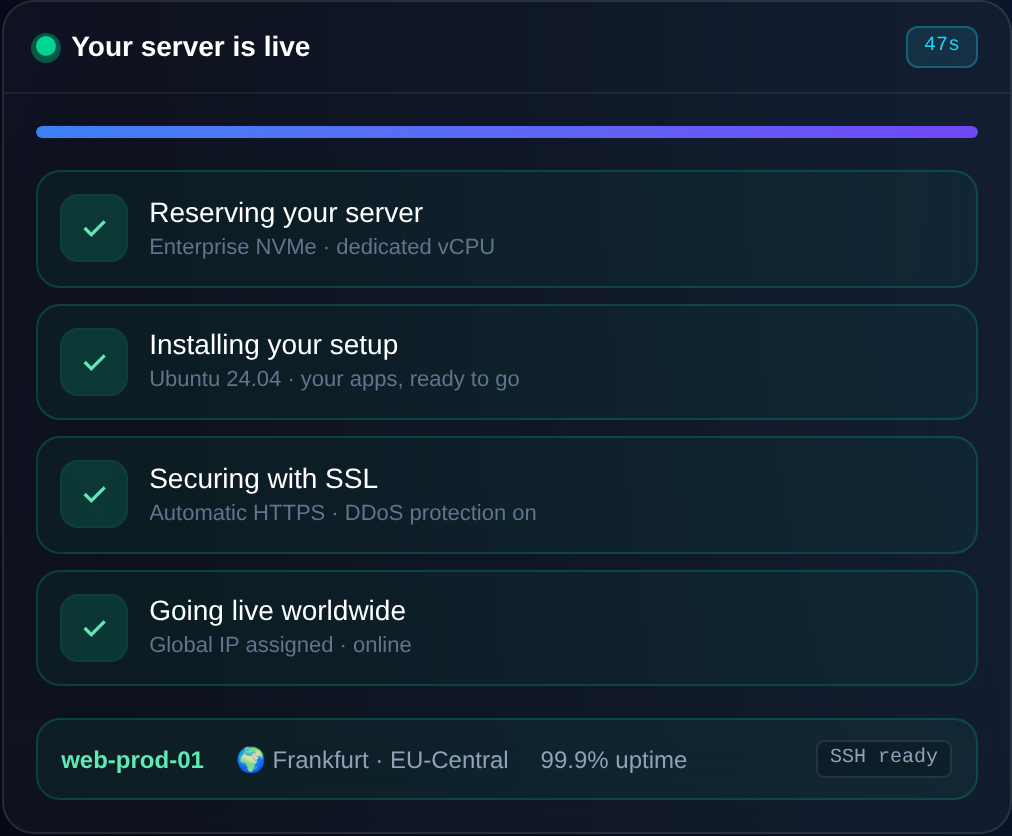
Give players a memorable address like play.yourserver.com instead of a raw IP. Here's how to point a domain at a Minecraft server.
A raw IP like 203.0.113.10 is hard to share and impossible to remember. A domain like play.yourserver.com looks professional and lets you change the underlying IP without telling everyone. This guide points a domain at a Minecraft server with DNS.
The simple case: an A record
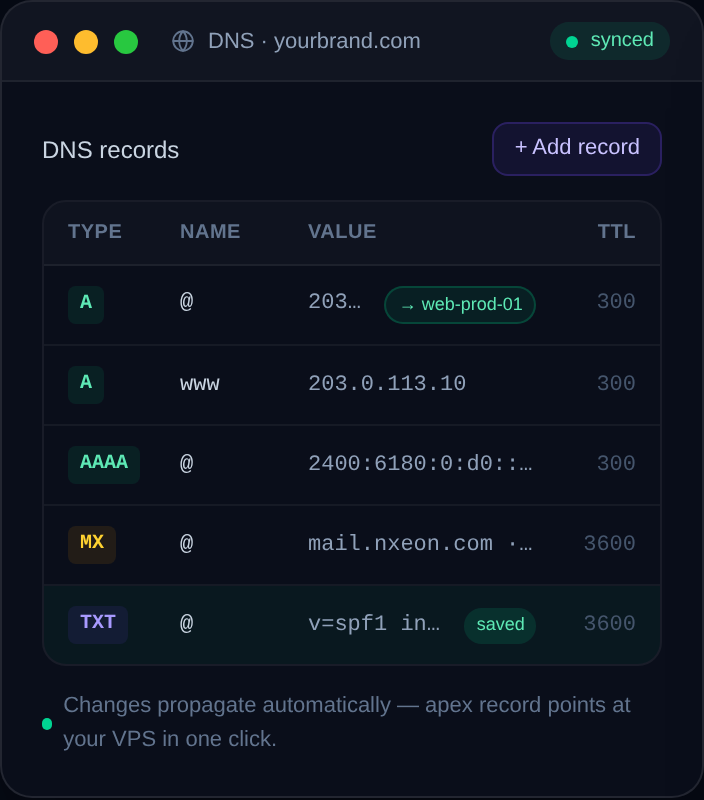
If your server runs on the default port (Java 25565), all you need is an A record pointing your domain or subdomain at the server's IP. In your DNS provider's dashboard:
- Type: A
- Name:
play(forplay.yourserver.com) or@for the root domain - Value: your server's IPv4 address
- TTL: 300–3600 seconds
Players then connect to play.yourserver.com with no port needed. This is the same DNS you'd use to point a domain to your VPS.
Non-standard port? Use an SRV record
If your server runs on a port *other* than 25565, an A record alone forces players to type domain:port. An SRV record hides the port so play.yourserver.com just works:
- Service:
_minecraft - Protocol:
_tcp - Name: the subdomain (e.g.
play) - Priority: 0, Weight: 5
- Port: your actual port (e.g. 25580)
- Target:
play.yourserver.com(an A record that resolves to your IP)
Most DNS panels present these fields directly. The SRV record is Java-only; Bedrock players still enter the port manually.
Verify it resolves
After adding the record, check it from your machine:
dig +short play.yourserver.com A
dig +short _minecraft._tcp.play.yourserver.com SRV
If dig returns your IP (and the SRV shows the right port), you're set. DNS changes can take time to propagate — if it doesn't work immediately, wait for the TTL and try again.
Bedrock and crossplay notes
On a Bedrock server, players enter the domain *and* the port (19132) — SRV records don't apply. For a crossplay server, publish both: an A record for everyone and, for Java, an SRV pointing at your Java port.
Why a domain beats a bare IP
Beyond looking clean, a domain means you can migrate to a new server or change hosts and just update the A record — players keep using the same address. That flexibility is a big reason to run on a VPS rather than a home connection.
TTL and propagation
When you create or change a DNS record, the TTL (time to live) tells resolvers how long to cache it. A lower TTL (300 seconds) means changes take effect quickly — useful when you're about to move servers. A higher TTL (3600+) means less DNS traffic but slower updates. If you're planning a server migration, drop the TTL to 300 a day beforehand so the cutover is fast, then raise it again once things are stable. New records can still take up to the old TTL to appear everywhere, so don't panic if it isn't instant.
Troubleshooting resolution
If the domain won't connect, work through it methodically with dig:
dig +short play.yourserver.com A            # should return your IP
dig +short _minecraft._tcp.play.yourserver.com SRV   # should show port + target
If the A record is missing or wrong, fix it in your DNS panel. If the SRV target points at a name that doesn't itself resolve to your IP, that's the usual SRV mistake — the SRV target must be a hostname with its own A record. Once DNS is right and the server's still unreachable, the problem is the firewall or the server — check port 25565 is open and the server is running. Our guide to pointing a domain to your VPS covers the DNS side in more depth.
One domain, many servers
Subdomains let you run several servers under one domain cleanly — survival.yourserver.com, creative.yourserver.com, each with its own A (and optional SRV) record pointing at the right IP and port. This is tidy for a small network and means players remember one root domain. If you later move to a VPS or change hosts, you just repoint the records — the addresses players type never change.
A or CNAME — which to use?
If your server has a stable IP, an A record pointing straight at it is simplest and best. Use a CNAME only when you want a subdomain to follow *another hostname* — for example pointing play.yourserver.com at a host address your provider gives you. A common mistake is trying to CNAME the root domain (yourserver.com with no subdomain), which most DNS standards disallow; use an A record there instead, and CNAMEs only on subdomains. For Minecraft's SRV setup, the SRV target should point at a name that resolves via an A record to your server. When in doubt, an A record on a subdomain like mc. or play. is the reliable default and what the guide to pointing a domain to your VPS recommends. This flexibility is a quiet superpower: change hosts, migrate the world, and just repoint the record — players never notice.
FAQ
How do I use a domain instead of an IP for Minecraft?
Add an A record pointing your (sub)domain at the server's IP. If the server uses a non-default port, add an SRV record so players don't need to type it.
What is an SRV record for Minecraft?
An SRV record advertises the service port for _minecraft._tcp, letting Java players connect to a custom port using just the domain name.
Why isn't my domain connecting to my server?
Give DNS time to propagate, confirm the A record points at the right IP, and check the firewall allows port 25565. Use dig to verify resolution.
Do I need a domain for a Minecraft server?
No, but it's worth it — it's memorable and lets you change servers without changing the address players use.
A tidy address makes your server feel legit. Grab one from Nxeon domains and pair it with Minecraft server hosting that keeps a stable IP behind it.
Game server hosting
Deploy in seconds, not weekends
Nxeon · Nxeon editorial
★★★★★ Straight-talking guides from the team that runs the servers.