
Read mail sent to you@yourdomain.com right in your normal Gmail inbox — and even reply as your domain. The simplest way to look professional without a new inbox.
If you just want mail sent to you@yourdomain.com to appear in your everyday Gmail — without paying for or managing a whole mailbox — email forwarding is the answer. This guide covers the easy setup, how to *reply* as your domain so it looks seamless, and when to graduate to real mailboxes.
How forwarding differs from a mailbox
A mailbox stores mail and lets you log in. Forwarding simply relays anything arriving at you@yourdomain.com onward to your Gmail, where it's stored. Forwarding is free or near-free and needs no separate inbox. The trade-off: to *send* as your domain you configure Gmail's "Send mail as," and true forwarding can slightly complicate deliverability (covered below).
For the full mailbox route instead, see how to set up business email on a custom domain.
Step 1: Set up forwarding at your DNS/registrar
Several registrars (Namecheap, Cloudflare Email Routing, and others) offer free email forwarding. The cleanest modern option is Cloudflare Email Routing:
- In Cloudflare, open Email → Email Routing and enable it.
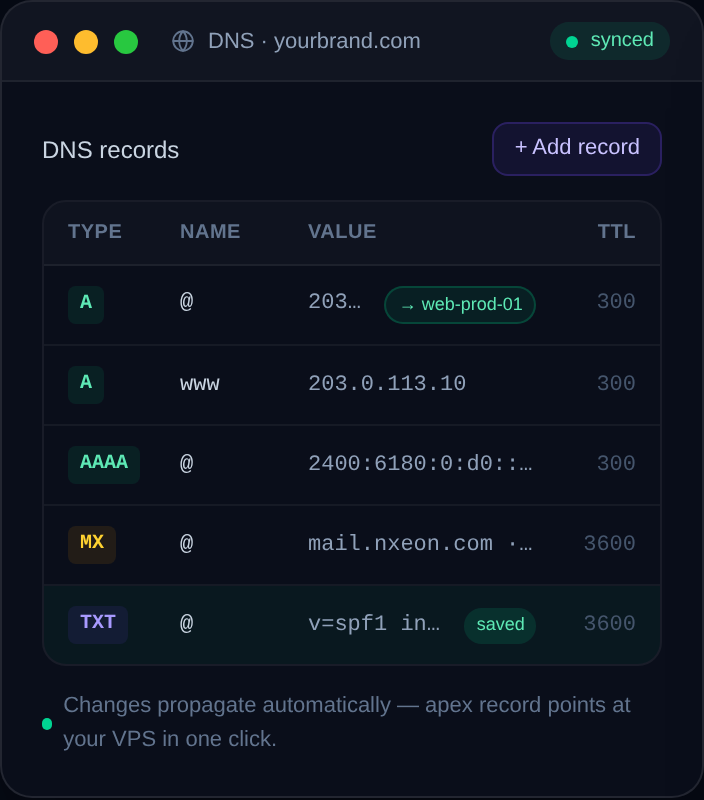
- Cloudflare adds the required MX and TXT records automatically:
example.com.  MX  10  route1.mx.cloudflare.net.
example.com.  MX  20  route2.mx.cloudflare.net.
example.com.  MX  30  route3.mx.cloudflare.net.
example.com. TXT "v=spf1 include:_spf.mx.cloudflare.net ~all"- Add a route:
you@example.com → youraddress@gmail.com, and verify your Gmail address by clicking the confirmation link.
That's it — mail to you@example.com now lands in Gmail. Note this replaces any existing MX records, so don't enable it if you also run Google Workspace on the domain.
Step 2: Reply as your domain from Gmail
Forwarding gets mail *in*; to reply *as* you@example.com set up "Send mail as":
- Gmail → Settings → Accounts and Import → Send mail as → Add another email address.
- Enter
you@example.com. - For the SMTP server, use an SMTP relay that authenticates as your domain (a transactional provider, or Gmail's own if you have Workspace). Forwarding alone doesn't give you outbound SMTP.
Without a proper SMTP relay, Gmail sends via its own servers and the From won't align with your domain's SPF/DKIM — which can hurt deliverability. That alignment issue is why heavy senders eventually want real mailboxes.
Step 3: Mind deliverability
Forwarded mail can trip SPF because the forwarding server isn't the original sender. Modern forwarders (like Cloudflare) handle this with SRS rewriting, but it's worth knowing. If you send outbound as your domain, publish SPF, DKIM and DMARC — how to set up SPF, DKIM and DMARC step by step — and keep an eye on how to stop your emails going to spam.
When to upgrade to real mailboxes
Forwarding is perfect for one or two addresses and light use. Move to real mailboxes when you:
- Have a team who each need their own login.
- Send a lot of outbound mail and need clean SPF/DKIM alignment.
- Want to keep sent mail and contacts on the domain, not scattered in personal Gmail.
A catch-all is a related trick for catching every address at once — see how to set up a catch-all email address.
The SPF/SRS caveat, explained
Here's the subtlety that makes forwarding occasionally flaky. When mail is forwarded, your server relays a message that was *originally* sent by someone else. The final recipient checks SPF against your forwarding server's IP — which isn't in the original sender's SPF — so plain forwarding can fail SPF and land in spam. Modern forwarders solve this with SRS (Sender Rewriting Scheme), which rewrites the return-path to a domain the forwarder controls so SPF passes. Cloudflare Email Routing and most reputable forwarders do this automatically; a hand-rolled .forward file on a raw server usually doesn't. If forwarded mail keeps hitting spam, SRS is the likely gap.
Forward several addresses cleanly
You'll usually want more than one address forwarded. Two approaches:
- Per-address routes: map
hello@,support@,billing@each to the same (or different) Gmail inboxes. Clean and spam-light. - Catch-all: forward *everything* at the domain to one inbox. Convenient, but it also forwards mail to every guessed address, so expect more spam — the trade-off is spelled out in how to set up a catch-all email address.
For most people, three or four explicit routes beat a catch-all.
Replying properly with an SMTP relay
Getting mail *in* is easy; replying *as* your domain so it doesn't look forwarded needs an authenticated SMTP relay in Gmail's "Send mail as." Point it at a service that can send for your domain and passes SPF/DKIM — a transactional provider, or Google Workspace if you upgrade. Without that, Gmail sends via its own servers and the From won't align with your domain's authentication, which recipients' filters notice. Publishing SPF, DKIM and DMARC — how to set up SPF, DKIM and DMARC step by step — keeps those replies out of spam. When you outgrow forwarding entirely, real mailboxes are covered in how to set up business email on a custom domain.
FAQ
Is email forwarding free?
Often yes — Cloudflare Email Routing and some registrars forward for free. You only pay when you want real mailboxes with storage and login.
Can I reply as my domain when using forwarding?
Yes, via Gmail's "Send mail as," but you need an authenticated SMTP relay for clean sending. Without one, replies go out via Gmail and won't align with your domain's SPF/DKIM.
Does forwarding hurt deliverability?
It can, because the forwarder isn't the original sender (SPF). Good forwarders use SRS to avoid this. For outbound, proper SPF/DKIM/DMARC is what matters.
Can I forward multiple addresses?
Yes — add a route per address, or set a catch-all so every address at your domain forwards to one inbox.
Will forwarded email show the original sender?
Yes. When mail is forwarded to your Gmail, it arrives with the original sender's address in the From field, so you see who really wrote it — the forwarding is transparent that way. What changes behind the scenes is the envelope return-path, which good forwarders rewrite (via SRS) so the message still passes SPF at your inbox. If you reply, though, Gmail defaults to sending from your Gmail address unless you've configured "Send mail as" for your domain, so the recipient would see your Gmail rather than you@yourdomain.com. That mismatch is the main reason to set up send-as with a proper SMTP relay. For simply reading and tracking who contacted you, forwarding preserves the original sender cleanly.
Forwarding is the quick win; a real mailbox on your domain is the upgrade. Get managed business email from Nxeon, or register your domain with Nxeon domains and forward from there.
Register a domain
Deploy in seconds, not weekends
Nxeon · Nxeon editorial
★★★★★ Straight-talking guides from the team that runs the servers.