
All the Mods packs are giant kitchen-sink modpacks. This guide sets up an ATM server on a Linux VPS and sizes it correctly.
All the Mods (ATM) is the flagship "kitchen sink" modpack series — hundreds of mods spanning tech, magic, and exploration in one pack. That scale makes it demanding to host. This guide sets up an ATM server and sizes it so it doesn't crawl.
Pick your ATM version first
Each pack (ATM9, ATM10, etc.) targets a specific Minecraft version, which dictates the Java you need:
- ATM9: Minecraft 1.20.1, so Java 17.
- Older packs (ATM6/7/8): 1.16–1.19, Java 8 or 17 depending on the pack.
Check the pack page, then install the right JDK:
sudo apt update
sudo apt install -y openjdk-17-jdk screen unzip
Download the server pack
On CurseForge, open the ATM pack and look for Server Files under the Files tab. That zip bundles Forge and every mod. Upload and unzip:
mkdir -p ~/atm && cd ~/atm
# upload Server-Files.zip, then:
unzip Server-Files.zip
Size it for a big pack
ATM packs are among the heaviest you can run. Do not starve them:
- Minimum: 6 GB for 2–3 players.
- Comfortable: 8–10 GB for a small group.
- CPU: fast single-thread performance is critical — worldgen and machines are demanding.
Our RAM sizing guide explains why these packs want so much headroom.
Accept the EULA and launch
The server pack usually includes a startserver.sh. Accept the EULA first, set memory, then run it:
echo "eula=true" > eula.txt
# edit memory in user_jvm_args.txt or the start script:
./startserver.sh
If the pack uses the modern Forge run.sh, set -Xmx8G -Xms8G in user_jvm_args.txt and pair it with the Aikar JVM flags — they make a big difference on packs this size.
Keep it running and backed up
Use a systemd service (see the Forge guide for the unit file), open port 25565, and — critically — back up frequently. Big packs mean big worlds you don't want to lose:
sudo ufw allow 25565/tcpPlayers must run the exact same ATM pack version via CurseForge or Prism. If you later want to change packs, our CurseForge modpack guide covers the general process, and the lag guide helps if worldgen chunks stutter.
Pre-generate the world
The single best thing you can do for a big-pack server is pre-generate chunks. With hundreds of mods adding ores, structures, and dimensions, generating terrain live as players explore causes severe lag spikes. Most ATM packs include the Chunky mod — run it from the server console:
/chunky radius 3000
/chunky start
Let it finish (it can take a while) before opening the server to players. Once chunks exist on disk, exploring them is cheap — and NVMe storage makes even that faster.
Watch the heavy mods
A few mod categories dominate resource use in kitchen-sink packs. Knowing them helps you diagnose lag with /spark or the pack's built-in profiler:
- Chunk-loading machines (quarries, item pipes across chunks) keep terrain ticking — the most common lag source on established bases.
- Large automated farms (mob or crop) create huge entity and tick loads.
- Worldgen-heavy mods cost most during exploration, which pre-generation solves.
Tune the server config
ATM packs respond well to the same settings as vanilla. In server.properties, a lower simulation distance frees a lot of headroom:
view-distance=8
simulation-distance=6
max-players=8
Combine that with the Aikar JVM flags sized for a large heap, and the tuning in our lag guide. Because ATM worlds represent a lot of collective effort, automated backups aren't optional — schedule them nightly. And when the pack releases a new version, treat it like any server update: back up, update the whole pack, and have players match their client.
Managing an ATM server day to day
Kitchen-sink packs come with tools that make ongoing management easier. Most ATM packs bundle Spark for profiling (/spark tps, /spark profiler) so you can find lag sources, and FTB Backups or a similar mod for scheduled in-game snapshots — though a server-side cron backup is still worth running as belt-and-braces. Because these packs receive frequent updates, decide early whether you'll update mid-world (possible but risky — always back up) or lock to a version for the life of the world. If players report a specific machine or dimension causing lag, profile it rather than guessing; the culprit is usually a chunk-loading contraption or an overgrown farm. A little routine maintenance keeps a big pack enjoyable for months. For the underlying loader, our Forge guide covers the systemd service and startup details.
FAQ
How much RAM does an ATM server need?
Start at 6 GB for a couple of players and 8–10 GB for a small group. These packs are genuinely heavy.
Which Java version for ATM9?
Java 17 — ATM9 is Minecraft 1.20.1. Always match Java to the pack's Minecraft version.
Why does my ATM server lag on world generation?
Generating chunks with hundreds of mods is CPU-intensive. Pre-generate chunks with a plugin/mod like Chunky and ensure fast single-thread CPU.
Do players need the modpack installed?
Yes — the identical ATM version through a launcher. Vanilla clients can't connect to a modded server.
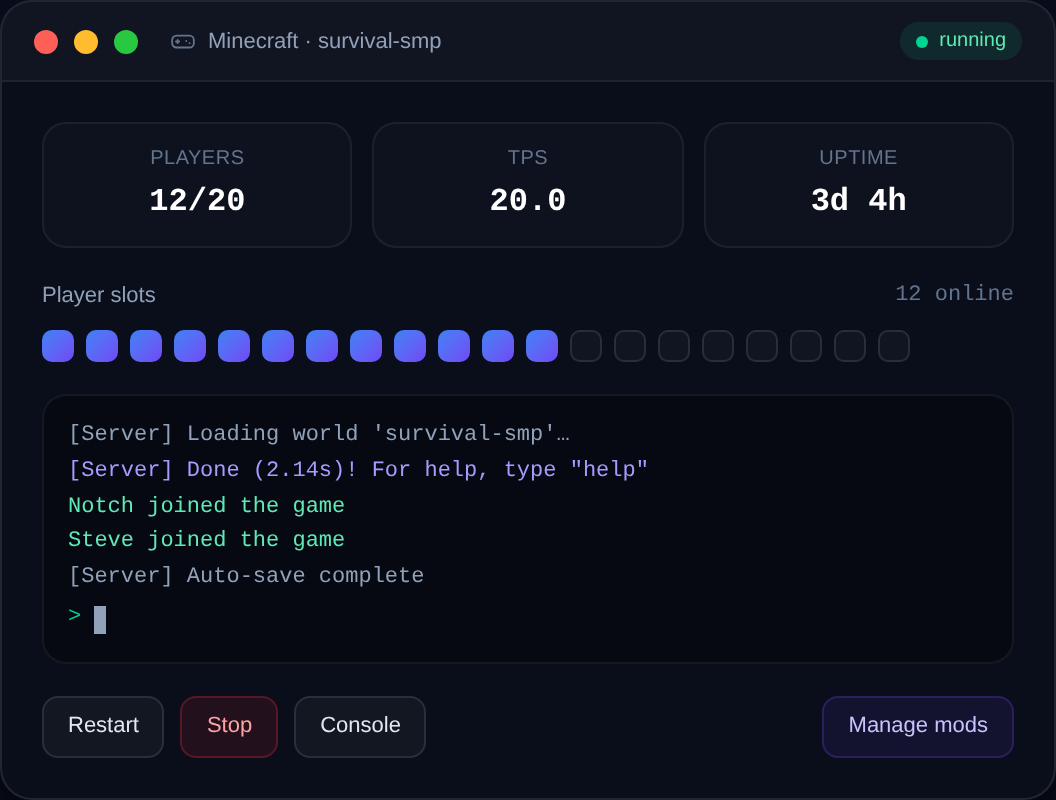
Kitchen-sink packs need serious RAM and NVMe speed to load hundreds of mods quickly. Nxeon's Minecraft server hosting offers the memory and root access ATM demands.
Game server hosting
Deploy in seconds, not weekends
Nxeon · Nxeon editorial
★★★★★ Straight-talking guides from the team that runs the servers.