






The Nxeon Blog
Guides for people who run their own servers.
Straight-talking tutorials and comparisons on VPS hosting, game servers, Linux and security. No fluff, just what actually works. 346 guides from the team that runs the servers.
Search results
7 guides for “nvme” in Networking · Clear search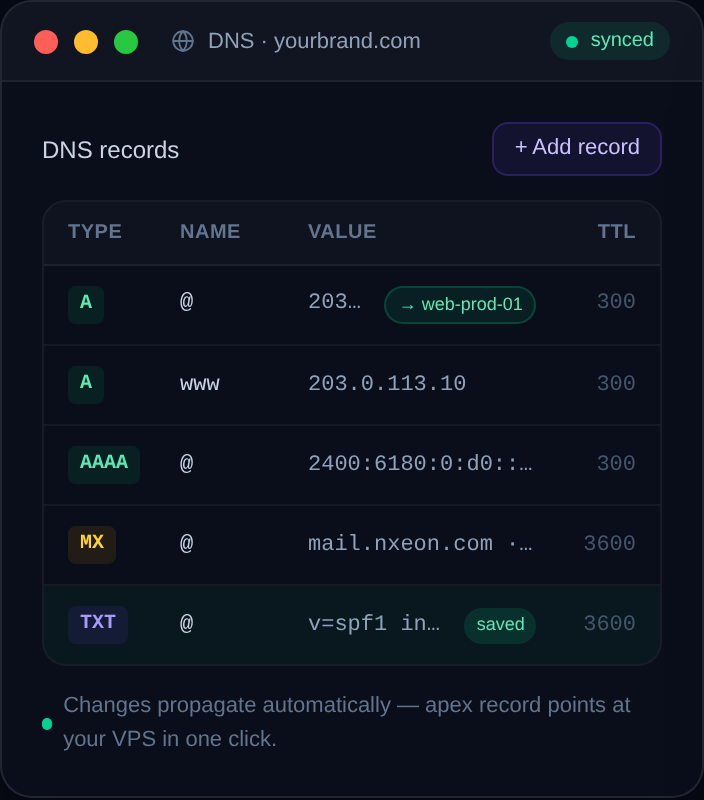
How to Diagnose DNS Problems with dig and nslookup
When a domain won't resolve, dig and nslookup tell you exactly why. A practical, example-driven guide to reading their output and finding the real problem.
How to Point a Subdomain to a Different App or Port
Run several apps on one VPS, each on its own subdomain — api.yourdomain.com, app.yourdomain.com — using a reverse proxy. DNS plus the Nginx and Caddy configs.
How to Set Up a TeamSpeak 3 Server on a VPS
Install a TeamSpeak 3 server on a Linux VPS: download the server, create a user, grab the admin token and ServerQuery password, open the ports, and run it with systemd.
How to Set Up a Mumble (Murmur) Voice Server
Host your own low-latency Mumble voice server with the Murmur daemon on a Linux VPS: install, configure mumble-server.ini, set the SuperUser password, and secure it.
How to point a domain at your VPS
Bought a domain and spun up a server? The last step is connecting them. Here's exactly how to point a domain at your VPS with A records — and verify it worked.
DNS records explained: A, AAAA, MX, TXT, CNAME, NS
DNS is the internet's address book. Here's a plain-English guide to the record types you'll actually use — A, AAAA, CNAME, MX, TXT and NS — and when to reach for each.
What is a WHOIS lookup and how to read the results
WHOIS tells you who owns a domain, when it expires, and where it's registered. Here's what every field means and how to read a WHOIS record like a pro.
Deploy your first server in under a minute.
Creating an account is free and takes no card details. Every guide here runs on a Nxeon VPS or game server.