Your business site is your storefront — it shouldn't share a slow, oversold server. Here's how to choose a VPS that's fast, reliable and professional without overspending.
Your website is often a customer's first impression, so a slow or flaky site costs real business. Shared hosting is cheap but oversold; a VPS gives your site dedicated resources and room to grow. Here's how to choose one that's professional and reliable without paying for capacity you don't need.
What a business site actually needs
Most small-business sites — a brochure site, a WordPress site, a booking page — are light. The priorities are reliability, speed and a professional setup, not raw power:
- 2 GB RAM runs a typical WordPress or CMS business site comfortably.
- 4 GB RAM gives headroom for growth, caching and a busier site.
- NVMe storage for fast page loads and quick backups.
- A data-centre region near your customers for low latency.
Speed builds trust (and SEO)
Fast sites convert better and rank better. On a VPS you can add proper caching, HTTPS and a modern web server — things shared hosting limits. If you're on WordPress, our best VPS for WordPress and how to speed up WordPress on a VPS with caching guides show how to get real speed. Add free HTTPS with Let's Encrypt so customers see the padlock.
Look professional: domain and email
A business needs a matching domain and email — you@yourbusiness.com, not a free Gmail. Point your domain at the VPS (our guide on how to point a domain to your VPS covers it) and set up proper business email with SPF, DKIM and DMARC so your mail lands in inboxes, not spam — see email DNS explained.
Don't skip backups and security
Downtime or a hacked site is a direct hit to reputation. A VPS lets you control both: enable a firewall, keep software updated, and run automatic backups. Our securing your first Linux VPS checklist is a solid starting point. If you'd rather not manage this yourself, a managed VPS handles the maintenance for you — see managed vs unmanaged VPS.
Reliability is a business feature
For a business site, downtime isn't just annoying — it's lost enquiries, sales and trust. A VPS lets you build in reliability that shared hosting can't guarantee:
- Dedicated resources mean a neighbour's traffic spike can't take your site down.
- Automatic backups let you recover fast from a bad update or mistake — set up automated backups and, crucially, test a restore so you know it works.
- A firewall and updates keep the box secure without constant attention — enable automatic security updates.
- Monitoring alerts you to trouble before customers notice; a simple uptime check emails you if the site goes down.
None of this requires you to be a sysadmin — one-click images and managed options handle the heavy lifting.
Room to grow without re-platforming
The quiet advantage of starting on a VPS is that it grows with the business. A brochure site today can become a booking system, an online store, or a customer portal tomorrow — all on the same server, or a quick resize to a bigger plan when traffic climbs. You're never forced to migrate to a different kind of hosting just because you added a feature.
That flexibility matters because re-platforming is disruptive and costly. Choosing a VPS early means:
- Add a database, an app, or a store whenever you're ready — full root, no artificial limits.
- Scale up in minutes rather than migrating to new infrastructure.
- Consolidate your site, staging environment and internal tools on one box if you like — see how to host multiple websites on one VPS.
For the fuller comparison, our why a VPS beats shared hosting for a growing site guide lays out exactly when the jump pays off.
Where Nxeon fits
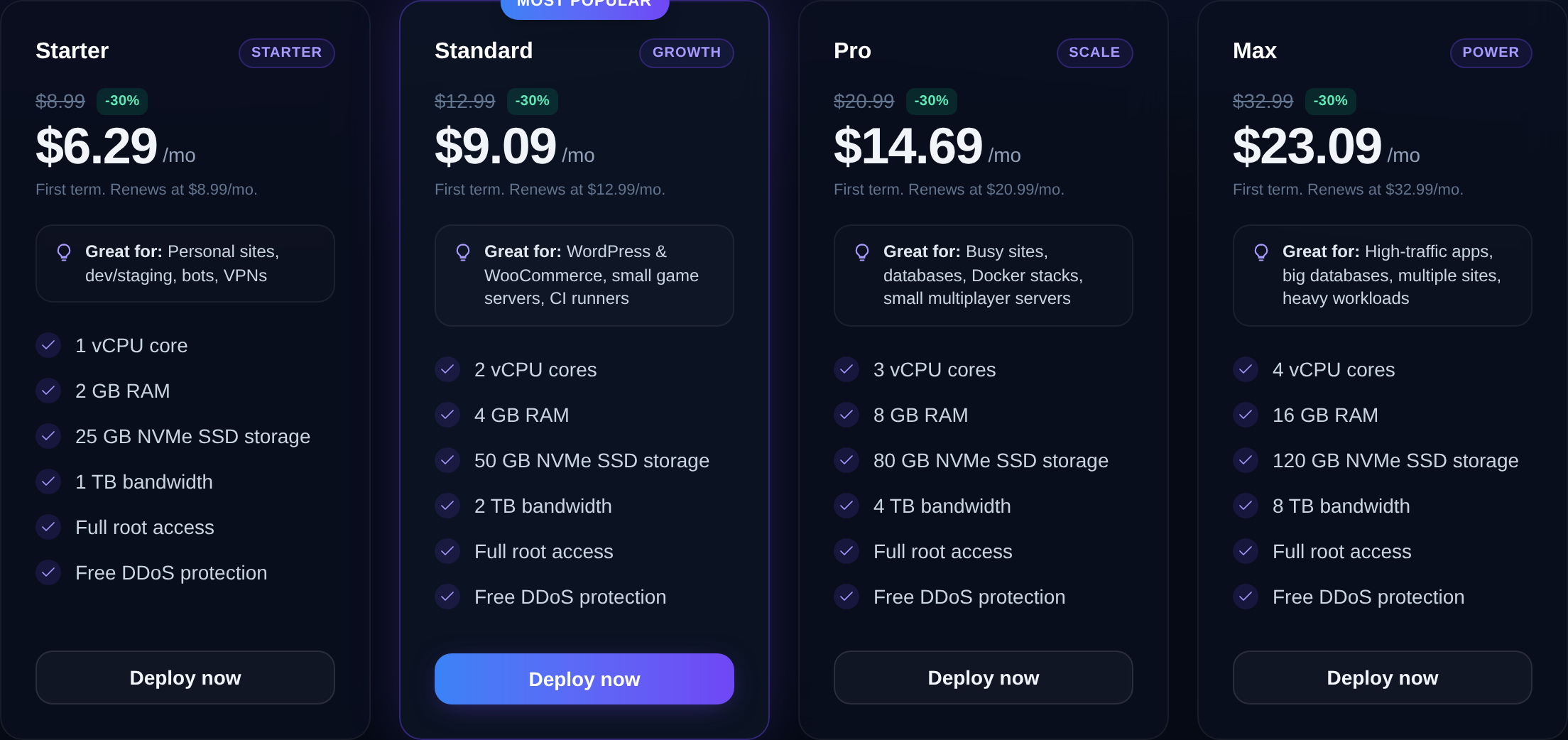
Nxeon runs NVMe KVM VPS with one-click OS images, full root and free migration help to move an existing site across without downtime. Add a domain and business email for a complete professional setup, and compare plans on the pricing page. If you're weighing shared hosting, our why a VPS beats shared hosting for a growing site piece lays out the case.
Buying checklist
- 2 GB RAM for a typical business site; 4 GB for growth.
- NVMe and a region near your customers.
- Free SSL and a matching domain + business email.
- Backups and a firewall — or a managed plan that handles them.
FAQ
Do I need a VPS for a small business website?
If your site is important to your business, a VPS is worth it. Dedicated resources mean faster, more reliable performance than oversold shared hosting, plus full control over security, email and backups.
How much does a business VPS cost?
Small business sites run well on entry-level plans, which are inexpensive. You pay a little more than shared hosting for dedicated resources, better speed and no noisy-neighbour slowdowns.
Can I run my website and email on the same VPS?
You can, though many businesses use dedicated business email so deliverability isn't tied to the web server. Either way, set up SPF, DKIM and DMARC so your mail reaches inboxes.
What if I'm not technical?
Choose a managed VPS or use one-click images and migration help. That removes most of the server maintenance while still giving you dedicated resources.
Ready for a professional setup? Compare plans on pricing, or get free migration help to move your current site across.
Web hosting
Deploy in seconds, not weekends
Nxeon · Nxeon editorial
★★★★★ Straight-talking guides from the team that runs the servers.