Discord bots need to run 24/7 without babysitting. Here's how to choose a small, reliable VPS that keeps your bot online — sizing, uptime and process management.
A Discord bot's job is to stay online — quietly, around the clock, without you leaving your laptop on. Free tiers sleep and disconnect; a small VPS keeps a bot up 24/7 for a few dollars a month. Here's how to pick and set one up.
Bots are light — buy small, buy reliable
Most bots barely touch CPU or RAM. The priorities are uptime and stability, not horsepower:
- 1 GB RAM comfortably runs one or several small bots (Node.js or Python).
- 2 GB RAM if a bot handles audio/music (heavier), does image processing, or you run many bots.
- Storage needs are tiny; NVMe still helps for fast restarts and logs.
The real question isn't "how big" but "how reliable" — a bot that drops offline nightly is worse than no bot. You want a host that stays up and a setup that restarts automatically.
Keep it running automatically
The classic mistake is launching the bot in an SSH session that closes when you disconnect. Use a process manager so it restarts on crash and after reboots.
For a Node.js bot with PM2:
npm install -g pm2
pm2 start bot.js --name my-bot
pm2 startup
pm2 save
For a Python bot, a systemd service does the same job cleanly. Our guide to automating restarts with systemd and cron applies directly — a bot is just a long-running process.
Secure your token and your box
Your bot token is a password — never commit it to a public repo. Store it in an environment variable or a .env file that's git-ignored. And lock down the VPS itself with a firewall and SSH keys, following securing your first Linux VPS. A bot doesn't need many open ports, so a tight firewall is easy.
Running Node or Python? Size accordingly
If your bot is Node-based, our best VPS for Node.js apps guide covers process management in depth. Python bots pair with best VPS for Python projects. Either way, a 1 GB plan is a fine starting point.
Deploy cleanly and update without downtime
A bot you can't easily update becomes a bot you stop improving. Set up a simple, repeatable deploy from the start:
- Keep your code in git and clone it to the server, so shipping an update is
git pullfollowed by a restart. - Store the token and config in a
.envfile that's git-ignored and loaded at runtime — never hard-code secrets in your source, and never commit them to a public repository. - Restart cleanly with
pm2 reload my-bot(Node) orsudo systemctl restart my-bot(Python) after each update.
Because a bot maintains a persistent gateway connection to Discord, a quick restart briefly disconnects it — schedule updates for quiet hours if your bot is busy.
Logging, monitoring and staying online
The frustrating part of bot hosting is a bot that silently dies. A few habits catch problems early:
- Capture logs. PM2 stores logs you can tail with
pm2 logs my-bot; systemd services log to the journal (journalctl -u my-bot). When the bot misbehaves, logs tell you why. - Auto-restart on crash is handled by your process manager, but also enable restart on reboot so a server restart doesn't leave the bot offline —
pm2 startup && pm2 savedoes this for Node. - Handle rate limits and reconnects in your code; the Discord API will occasionally throttle or drop connections, and a resilient bot reconnects automatically rather than crashing.
- Consider a lightweight uptime check that alerts you if the bot goes offline, so you're not relying on users to report it.
With full root on a small VPS, all of this is straightforward — and far more reliable than free hosting tiers that sleep after inactivity. If your bot handles music or heavier workloads, our best VPS for Node.js apps guide covers scaling up.
Where Nxeon fits
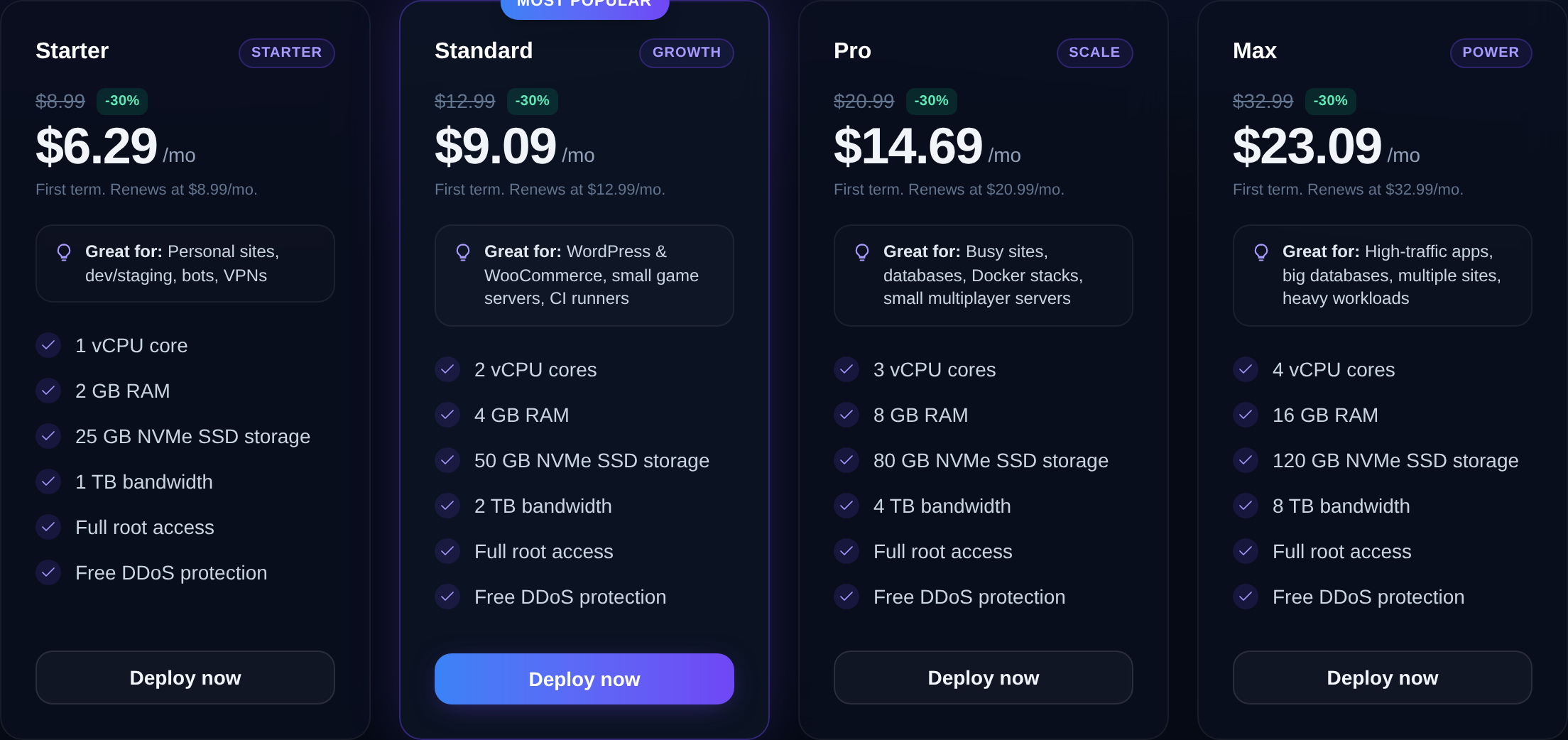
Nxeon's smaller NVMe VPS plans are ideal for bots: full root to run any Node or Python version, a process manager for 24/7 uptime, and honest pricing that starts low. There's dedicated Discord bot hosting if you want a quick start, and the developers page shows the wider toolset.
Buying checklist
- 1 GB RAM is plenty for most bots; step up for audio/music bots.
- Prioritise uptime and stability over raw specs.
- Set up a process manager for automatic restarts.
- Keep your token secret and the box firewalled.
FAQ
How much does it cost to host a Discord bot?
Very little. A small VPS that keeps a bot online 24/7 typically costs a few dollars a month — far more reliable than free tiers that sleep or disconnect after inactivity.
What size VPS do I need for a Discord bot?
A 1 GB plan runs most bots comfortably, including several small ones. Move to 2 GB if your bot streams audio/music, processes images, or you host many bots on one box.
How do I keep my Discord bot online 24/7?
Run it under a process manager like PM2 (Node) or a systemd service (Python) so it restarts automatically on crash and after reboots — not in an SSH session that closes when you disconnect.
Can I run multiple bots on one VPS?
Yes. Full root lets you run several bots side by side with PM2 or systemd. A 1–2 GB plan handles a handful of light bots easily.
Ready to keep your bot online? See Discord bot hosting or compare small plans on pricing.
Cloud VPS hosting
Deploy in seconds, not weekends
Nxeon · Nxeon editorial
★★★★★ Straight-talking guides from the team that runs the servers.