The terms overlap and marketing muddies them further. Here's a plain-English comparison of VPS and cloud hosting, and how to tell which one you actually need.
"VPS" and "cloud hosting" get used interchangeably, and marketing blurs the line further. In practice they overlap a lot — a VPS *is* a form of cloud infrastructure — but there are real differences in pricing, scaling and predictability. Here's a plain-English comparison to help you choose.
What a VPS is
A VPS (Virtual Private Server) is a slice of a physical server, virtualized so you get dedicated CPU, RAM and storage with full root access. You pick a plan, you get fixed resources, and you pay a flat monthly price. It behaves like your own Linux box. If you want the fundamentals, start with what is a VPS.
What "cloud hosting" usually means
"Cloud hosting" is a broader, fuzzier term. Usually it points to one of:
- Hyperscaler platforms (AWS, Google Cloud, Azure) with hundreds of services, pay-per-use billing and elastic scaling.
- Managed app platforms that abstract the server away entirely.
The defining traits people mean by "cloud" are elastic scaling and usage-based billing — you can add resources on demand and pay for what you consume.
The real differences that matter
- Pricing model: VPS is flat and predictable; cloud is often usage-based and can spike with traffic. Predictability is a genuine advantage of a VPS.
- Scaling: cloud platforms scale horizontally on demand; a VPS scales by resizing to a bigger plan (still easy, just not automatic).
- Complexity: hyperscaler clouds are powerful but complex, with steep learning curves and surprise bills. A VPS is one server you understand.
- Control: a VPS gives you full root and a simple mental model. Managed cloud platforms trade control for automation.
For a wider view across hosting types, see VPS vs shared vs dedicated vs cloud hosting.
Which should you choose?
- Choose a VPS when you want predictable pricing, full control, and a single server you can reason about — most websites, apps, game servers and side projects fit here.
- Choose a hyperscaler cloud when you genuinely need elastic auto-scaling, a global multi-region footprint, or a big menu of managed services — and you have the expertise (or budget) to manage the complexity and billing.
Many teams over-reach for "the cloud" and end up with a complex, expensive setup where a straightforward VPS would have been faster, cheaper and easier. If you're deciding between VPS and a single big machine instead, read VPS vs dedicated server.
The hidden cost of "the cloud": complexity and billing
The reason so many teams reach for a hyperscaler and later regret it comes down to two things: complexity and unpredictable bills. A big cloud platform offers hundreds of services, each with its own concepts, permissions and pricing. That power is real, but for a single website or app it's mostly overhead you have to learn, configure and secure.
The billing model compounds it. Usage-based pricing sounds efficient, but it means:
- Costs are hard to predict — a traffic spike, a misconfigured service, or an egress-heavy month can produce a surprising bill.
- Egress (data transfer out) is often charged separately and adds up quietly.
- You pay for many small services that a single VPS would bundle for free.
For a workload that runs steadily around the clock, a flat-rate VPS is usually cheaper *and* far easier to budget, because you know the number before the month starts.
Match the tool to the project
The honest way to choose is to be clear-eyed about what you actually need:
- A website, blog, store, app, game server or side project almost always fits a VPS perfectly — predictable cost, full control, one server to understand.
- A globally-distributed application needing multi-region failover, elastic auto-scaling to handle huge, spiky load, and a big menu of managed services genuinely benefits from a hyperscaler — if you have the expertise to run it.
- Somewhere in between? Start on a VPS. It's cheaper to begin, and you can always add infrastructure later. Over-engineering for scale you don't have yet is a common and expensive mistake.
For the wider landscape, our VPS vs shared vs dedicated vs cloud hosting guide compares every option, and what is a VPS covers the fundamentals.
Where Nxeon fits
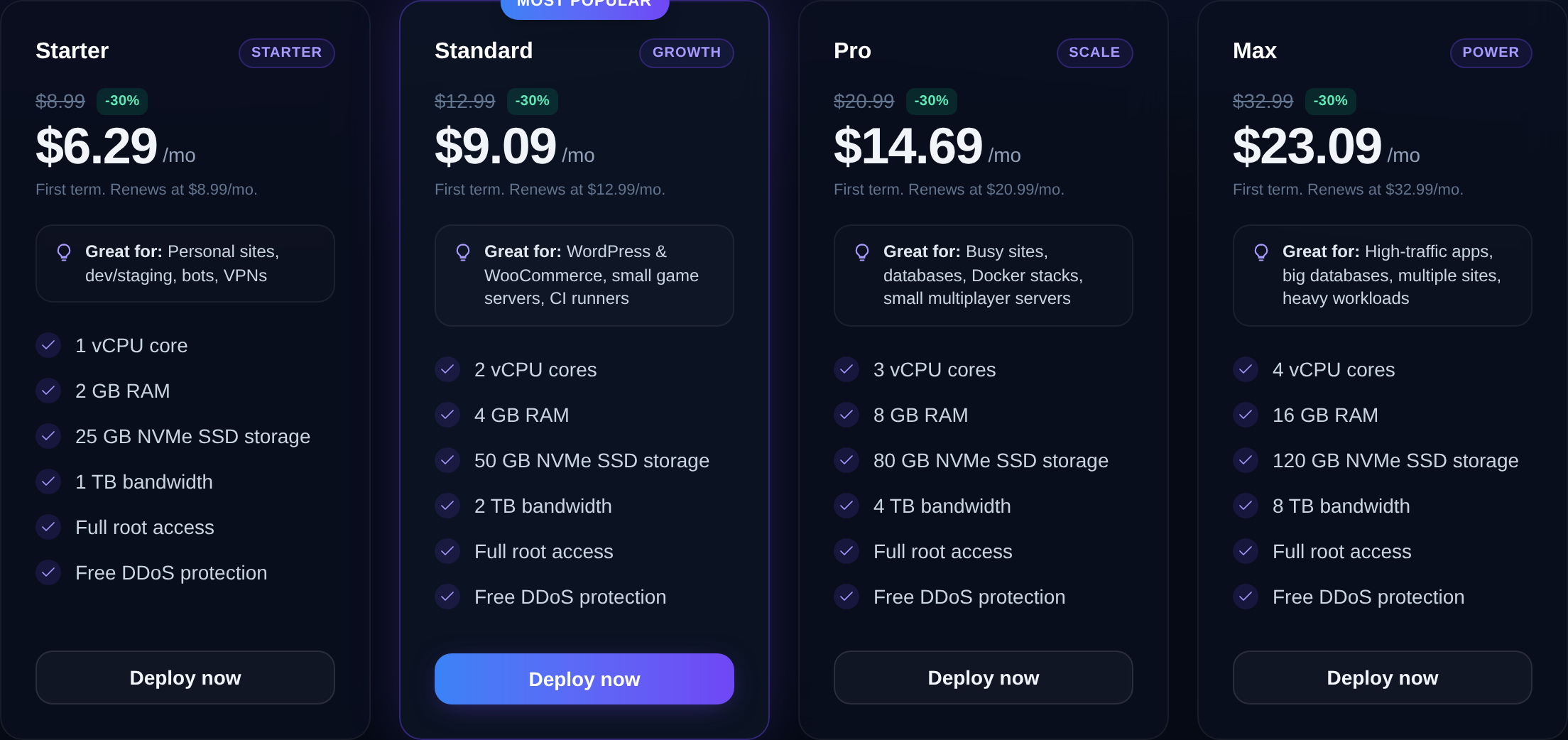
Nxeon provides VPS-style cloud infrastructure done simply: NVMe KVM instances with flat, predictable pricing, full root and one-click images — the cloud benefits (virtualized, resizable, provisioned in minutes) without the hyperscaler complexity or bill shock. Explore the VPS overview or compare plans on pricing.
FAQ
Is a VPS the same as cloud hosting?
They overlap — a VPS is virtualized cloud infrastructure. The usual distinction is that "cloud hosting" implies elastic auto-scaling and usage-based billing, while a VPS gives you fixed resources at a flat monthly price.
Is cloud hosting cheaper than a VPS?
Often not, for steady workloads. Usage-based cloud billing can be cost-effective for spiky traffic but unpredictable and pricey for a site running around the clock, where a flat-rate VPS is cheaper and easier to budget.
Can a VPS scale like the cloud?
A VPS scales by resizing to a larger plan, which is quick but not automatic. True elastic auto-scaling is a hyperscaler-cloud feature. For most projects, resizing a VPS is more than enough.
Which is easier to manage?
A VPS is simpler — one server, full root, a clear mental model. Hyperscaler clouds are more powerful but far more complex, with more services to learn and bills to watch.
Want simple, predictable cloud infrastructure? See the VPS overview or compare plans on pricing.
Cloud VPS hosting
Deploy in seconds, not weekends
Nxeon · Nxeon editorial
★★★★★ Straight-talking guides from the team that runs the servers.